

ADHD Presentation Finder
Understanding ADHD Presentations
This tool clarifies the three clinically recognized ADHD presentations from the DSM-5. There are no "levels" of ADHD - only different symptom patterns. What matters is how symptoms impact daily functioning, not ranking.
Inattentive Presentation
Common Traits
- Difficulty focusing
- Forgets deadlines
- Struggles with organization
Real-life example:
"Sits quietly in meetings but forgets important tasks and loses track of time."
Hyperactive-Impulsive Presentation
Common Traits
- Constant movement
- Interrupting others
- Impulsive decisions
Real-life example:
"Struggles to sit still in class and speaks without thinking."
Combined Presentation
Common Traits
- Both inattentive and hyperactive symptoms
- Difficulty focusing AND restlessness
Real-life example:
"Can't sit still AND frequently loses track of conversations."
Why "Levels" Are Misleading
Levels imply hierarchy - suggesting one person's ADHD is "worse" than another's. This is stigmatizing and inaccurate. ADHD is a spectrum of neurodiversity, not a ranking system.
What Actually Matters
Clinicians focus on functional impairment, not levels. Consider:
- Can you hold down a job?
- Do you regularly miss appointments?
- Can you pay bills on time?
- Do you feel overwhelmed by simple tasks?
There are no five levels of ADHD. Not in the medical world. Not in the DSM-5. Not in any credible clinical guideline. If you’ve heard someone say there are five levels of ADHD, they’re mixing it up with something else-maybe autism spectrum levels, or a YouTube video that turned a simple checklist into a fake ranking system.
ADHD Doesn’t Work Like a Video Game Difficulty Setting
People often want to put complex conditions into neat boxes. ‘Level 1: mild,’ ‘Level 5: severe.’ It feels easier to understand. But ADHD isn’t a video game where you unlock harder modes as you progress. It’s a neurodevelopmental disorder with a wide range of how it shows up in different people. The symptoms can shift over time, get worse under stress, or look completely different in kids versus adults.
The American Psychiatric Association’s Diagnostic and Statistical Manual of Mental Disorders (DSM-5) lists three presentations of ADHD: inattentive, hyperactive-impulsive, and combined. That’s it. No levels. No rankings. No tiered system. These are not severity levels-they’re symptom patterns. Someone with the inattentive presentation might sit quietly in meetings but forget every deadline. Someone with the hyperactive-impulsive presentation might interrupt constantly and struggle to sit still. The combined type has symptoms from both.
That’s why you’ll never see a doctor say, ‘You’re at Level 3 ADHD.’ They’ll say, ‘You meet criteria for ADHD, combined presentation.’ And then they’ll talk about how it’s affecting your life-not what level you’re on.
Where Did the ‘Five Levels’ Idea Come From?
There’s a lot of misinformation online. Some influencers, wellness coaches, or self-help gurus have turned ADHD into a personality quiz. You answer five questions, get a score, and boom-you’re ‘Level 2 ADHD.’ These quizzes often borrow language from autism spectrum disorder (ASD), where levels of support need are officially recognized. But ADHD doesn’t work that way.
Some websites even sell ‘ADHD level assessments’ as downloadable PDFs or paid courses. They might use terms like ‘mild,’ ‘moderate,’ ‘severe,’ ‘crippling,’ and ‘overwhelming.’ These aren’t clinical terms. They’re marketing hooks. They sound scientific, but they’re not backed by research or medical organizations like the CDC, the American Academy of Pediatrics, or the National Institute of Mental Health.
Even the word ‘levels’ implies a hierarchy. It suggests one person’s ADHD is ‘worse’ than another’s. That’s not helpful. It’s stigmatizing. Someone with mostly inattentive symptoms might struggle silently for years because they don’t ‘look like’ they have ADHD. That doesn’t make their experience less real.
What Actually Matters: Functioning, Not Labels
What clinicians care about is how ADHD impacts daily life. Can you hold down a job? Do you regularly miss appointments? Can you pay bills on time? Do you forget important conversations? Do you feel overwhelmed by simple tasks? These aren’t ‘levels.’ They’re functional impairments.
Two people might both have the combined presentation of ADHD. One might manage it with medication, therapy, and a structured routine. The other might not have access to care, live in chronic stress, and struggle with co-occurring anxiety. Their symptoms might look similar on paper, but their outcomes are worlds apart. That’s why treatment is personalized-not ranked.
There’s no official scale to measure ‘how much ADHD’ someone has. Instead, doctors use rating scales like the Conners Scale or the Adult ADHD Self-Report Scale (ASRS-v1.1) to track symptoms over time. These tools help monitor progress, not assign levels.

Why This Misinformation Spreads
ADHD is misunderstood. For decades, it was seen as just a ‘kid’s disorder’ or something you ‘outgrow.’ Now that more adults are being diagnosed, people are scrambling to make sense of it. Social media thrives on simple answers. ‘Five levels of ADHD’ sounds like something you can memorize. It’s catchy. It’s shareable.
But real understanding takes time. Real help takes effort. It takes finding a qualified professional-psychiatrist, psychologist, or neurologist-who knows the difference between a viral trend and a diagnostic standard. It takes accepting that ADHD doesn’t fit into a five-point scale. It’s messy. It’s personal. It’s unique to each person.
What to Do Instead of Looking for Levels
If you’re trying to understand your own ADHD-or someone else’s-skip the levels. Focus on these five practical steps:
- Get evaluated by a licensed professional. Not a quiz. Not an app. A real clinical assessment.
- Track your symptoms over time. Use a journal or app to note when focus fails, when impulsivity spikes, when tasks pile up.
- Identify your triggers. Is it lack of sleep? Too much caffeine? A noisy environment? Stress?
- Explore treatment options. Medication works for some. Behavioral therapy, coaching, and organizational tools work for others. Many use a mix.
- Build systems, not willpower. ADHD isn’t about being lazy. It’s about executive dysfunction. Use reminders, timers, checklists, and accountability partners.
There’s no ‘Level 5’ that makes you more deserving of help. There’s no ‘Level 1’ that means you’re faking it. Your struggle is valid no matter how it looks to someone else.
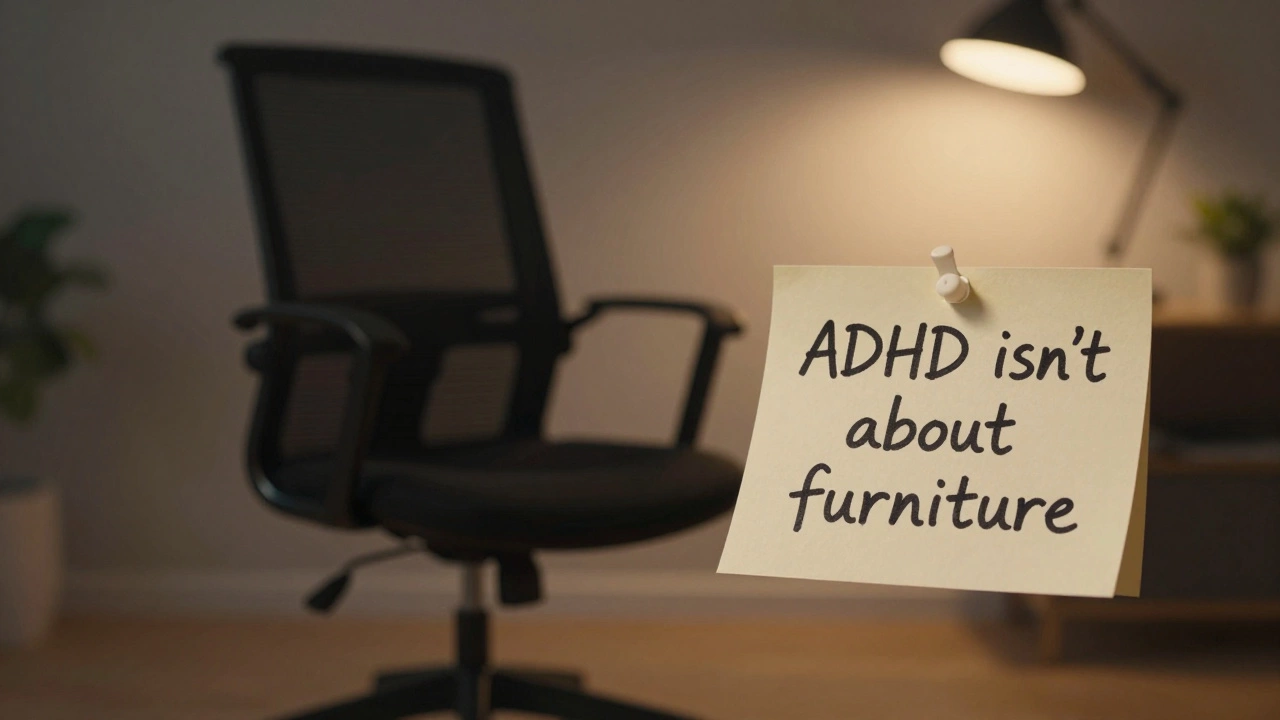
Office Chairs Have Nothing to Do With This
Let’s be clear: ADHD is not about furniture. You can buy the most ergonomic office chair in the world-adjustable lumbar support, memory foam, 360-degree swivel-and it won’t fix your brain’s difficulty with working memory or emotional regulation. That’s not what chairs are for. They’re for posture. ADHD is about neurology.
If you’re reading this because you saw an ad for an ‘ADHD-friendly office chair’ that promised to ‘reduce symptoms by 80%,’ you’re being misled. No chair can do that. Some chairs might help with physical comfort, which can reduce distraction from back pain. But they don’t treat ADHD. Don’t confuse comfort with cure.
Focus on what actually helps: structure, support, and science-not marketing gimmicks disguised as solutions.
Final Thought: ADHD Is a Spectrum, Not a Ranking
ADHD exists on a spectrum-not because it has levels, but because every brain is wired differently. Two people with the same diagnosis can have opposite strengths and struggles. One might be brilliant at creative problem-solving but terrible at filing taxes. Another might ace deadlines but can’t sit through a family dinner without fidgeting.
What matters isn’t what level you’re on. It’s what you need to thrive. And that’s different for everyone.
Write a comment