
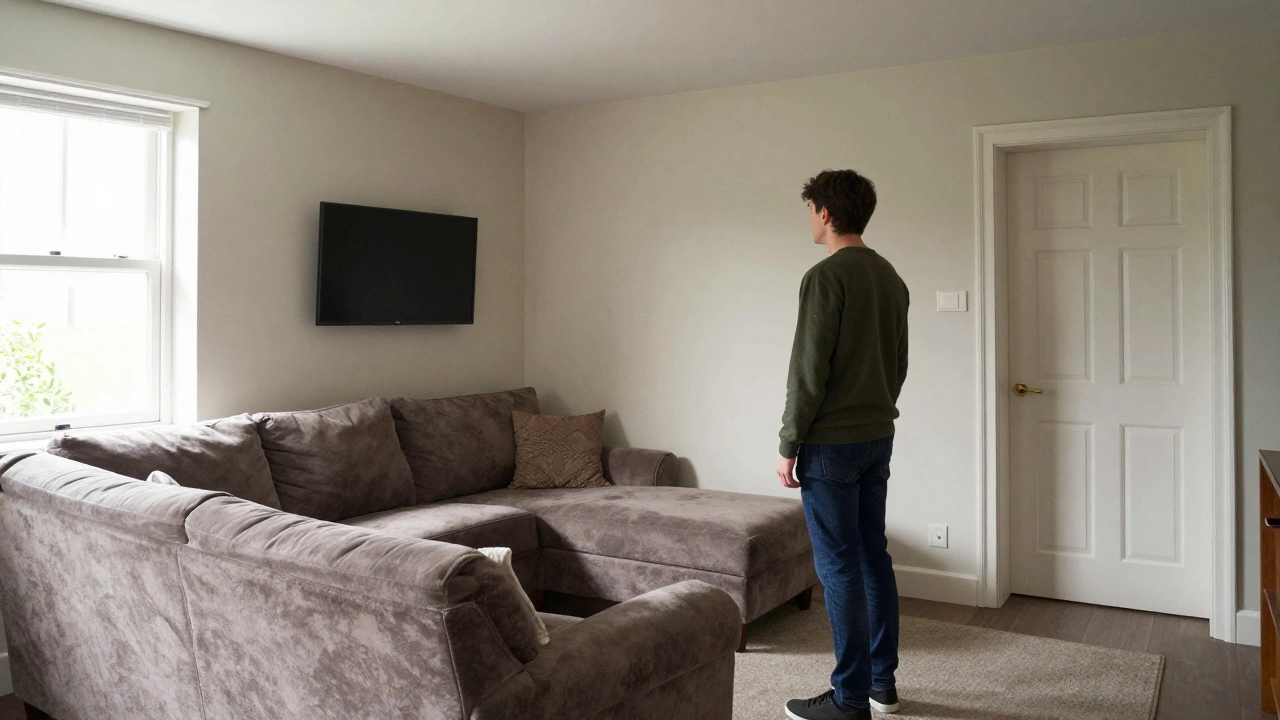
Corner Sofa Orientation Checker
Find the perfect sofa orientation for your space
Based on your room layout, we'll tell you which orientation works best. No more guessing!
Room Layout
Answer these questions to get your recommendation
Ever stared at a sofa listing and wondered what "left-hand facing" actually means? You’re not alone. It’s one of those terms that sounds simple until you’re standing in a showroom, holding a tape measure, and realizing your dream sofa might end up facing the wrong way. If you’ve ever bought a corner sofa only to find it blocks the TV, crowds the doorway, or just feels awkward in your space, you’ve felt the pain of not understanding orientation. Let’s clear this up-once and for all.
What "Left-Hand Facing" Actually Means
When a corner sofa is labeled "left-hand facing," it means that when you stand in the room and face the sofa, the corner and the longest section are on your left side. It’s not about which way the sofa faces in the room-it’s about where the corner is positioned relative to your viewpoint.
Think of it like this: walk into your living room and pretend you’re about to sit down. Now, look at the sofa. If the long piece runs along the left wall and the corner turns toward the center of the room from that side, it’s a left-hand facing sofa. The chaise or extended section is on the left when you’re facing it.
This isn’t just semantics. Getting this wrong means your sofa might end up blocking the window, turning your favorite reading nook into a dead zone, or forcing you to climb over the armrest just to get to the TV remote. And no, you can’t just flip it around-corner sofas are designed with fixed angles and often have built-in storage or recliners on one side only.
Why Orientation Matters More Than You Think
Most people think a sofa is just a place to sit. But in a real home, furniture shapes how you move, talk, and live. A left-hand facing sofa works best in rooms where the main traffic flow comes from the right. For example, if your doorway is on the right side of the room, a left-hand facing sofa lets people walk past without bumping into the chaise.
It also affects sightlines. If your TV is mounted on the left wall, a left-hand facing sofa puts you directly in front of it. But if the TV is on the right, you’ll be sitting at an angle-straining your neck to watch. Same goes for fireplaces, windows, or even the kitchen opening into the living area. The sofa’s orientation determines whether you’re facing the view or turned away from it.
I’ve seen too many homes where people bought a "corner sofa" without checking the orientation, only to realize they’d accidentally blocked the only good light in the room. The sofa looked great in the catalog. In real life? It turned the living room into a dark, cramped hallway.
How to Tell Left-Hand from Right-Hand Facing
Here’s the easiest way to figure it out-no measuring tape needed.
- Stand in the room where you plan to put the sofa.
- Face the spot where the sofa will go.
- Look at the corner. Is the long section running along your left side? Then it’s left-hand facing.
- If the long section runs along your right side, it’s right-hand facing.
That’s it. No charts, no confusing diagrams. Just your own perspective.
Most online retailers show this clearly in their product images. Look for the arrow on the diagram-it usually points toward the chaise. If the arrow points left, it’s left-hand facing. If it points right, it’s right-hand facing. If there’s no arrow, check the description: "L-shaped corner sofa with chaise on left" means left-hand facing.
Pro tip: If you’re shopping in person, ask the salesperson to show you the sofa from the viewer’s perspective-not from the back of the store. They’ll often turn it around to make it look better. Always ask: "Which way is the chaise when you’re standing in front of it?"

Common Mistakes People Make
Here are the three most common errors:
- Assuming "left-hand" means the sofa turns left when you sit on it. It doesn’t. It’s about your position in the room.
- Buying a sofa based on the picture alone without checking the orientation. Photos can be flipped.
- Thinking you can change the orientation after delivery. You can’t. These sofas are built as a single unit.
One customer in Birmingham bought a left-hand facing sofa because it matched the color scheme. She didn’t realize the chaise blocked her kitchen entrance. By the time she noticed, the delivery truck was gone. She spent £180 on a custom mover just to turn it around-only to find it still didn’t fit because the corner hit the radiator.
Always measure. Always visualize. Always stand in the spot and imagine the sofa there.
What to Do If You’re Still Unsure
If you’re stuck, try this trick: use masking tape on the floor.
Grab a roll of painter’s tape and lay out the approximate shape of the sofa. Mark where the corner would be. Then walk around it. Does it feel natural? Can you reach the TV? Can someone walk past without tripping? Does the light from the window still hit the floor where you want to sit?
You can also sketch it. Even a quick doodle on a notepad helps. Draw your room, mark the door, window, TV, and radiator. Then draw the sofa in two ways-left-hand and right-hand. See which one opens up the space.
Most furniture stores now offer free 3D room planners online. Use them. Upload your room dimensions, drop in the sofa model, and rotate it. You’ll see instantly if it works.
When to Choose Left-Hand Facing
Left-hand facing corner sofas work best when:
- Your main seating area faces the TV on the left wall
- The doorway or hallway enters from the right side of the room
- You want the chaise to stretch along a window for natural light
- You have a fireplace or bookshelf on the left side you want to face
- You’re placing the sofa in a room where people typically enter from the right
It’s also the more common configuration in UK homes, simply because most living rooms are arranged with the TV on the left when facing the main seating area.
But don’t just copy your neighbor. Your room is yours. The right choice depends on your layout-not trends.
Final Tip: Always Check the Dimensions
Even if you get the orientation right, the sofa might still not fit. Corner sofas take up a lot of space. A typical left-hand facing model is about 240cm wide and 220cm deep. The chaise alone can be 160cm long. Make sure you’ve got at least 30cm of clearance on all sides for walking and opening doors.
Measure your doorway, hallway, and stairwell too. Some corner sofas come in two pieces, but others are one solid unit. If you live in a flat or have a narrow staircase, you might need to pick a modular design that can be carried in pieces.
And don’t forget the height. Some corner sofas have tall backs that won’t fit under low ceilings or through archways.
Measure twice. Buy once.
What to Do Next
Now that you know what "left-hand facing" means, here’s your action plan:
- Stand in your living room and face the spot where the sofa will go.
- Identify where the corner would be-left or right?
- Check your TV, windows, doorways, and radiators. Which side makes more sense?
- Use masking tape to mark the shape on the floor.
- Only then, look at sofas that match that orientation.
Don’t let a simple term ruin your living room. Once you understand orientation, you’ll never buy a corner sofa blindly again.
Is a left-hand facing sofa the same as a left-arm chaise?
Yes, they mean the same thing. "Left-arm chaise" refers to the side where the extended seating (the chaise) is located when you’re sitting on the sofa. If the chaise is on your left armrest when you sit facing the sofa, it’s a left-arm chaise, which is the same as a left-hand facing sofa.
Can I turn a left-hand facing sofa into a right-hand facing one?
No. Corner sofas are built as a single, fixed unit. The frame, cushions, and sometimes even the internal mechanisms (like recliners or storage) are designed for one orientation. You can’t flip or rotate them without damaging the structure.
Do all corner sofas come in left and right options?
Most do, but not all. Some designs, especially curved or L-shaped models, are only available in one orientation. Always check the product details before buying. If it doesn’t say "left-hand" or "right-hand," assume it’s fixed.
Why do some websites show the sofa flipped in the picture?
Retailers sometimes flip images to make the sofa look better in the photo-like showing it next to a window or away from a cluttered wall. That’s why you should always read the description and look for orientation indicators like arrows or labels. Never rely on the image alone.
How do I know if my room is suitable for a corner sofa?
Measure your room’s width and depth. A corner sofa needs at least 2.5 meters in both directions to fit comfortably. Also check doorways, stairwells, and hallways. If you can’t get the sofa through, you’ll need a modular design. And make sure there’s space to walk around it-leave at least 60cm of clearance on all sides.
Write a comment