

Sofa Value Calculator
Compare Your Sofa Investment
Calculate real value based on your usage and lifespan expectations.
Your Results
Cheap Sofa
Total cost over 20 years
Number of replacements:
Annualized cost:
Expensive Sofa
Total cost over 20 years
Number of replacements:
Annualized cost:
{{ comparisonTitle }}
{{ comparisonMessage }}
Key Insight
This calculation reflects the article's findings:
Expensive sofas last longer and cost less per year when you consider replacement costs.
When you see a sofa that costs £3,000 or more, it’s easy to think: Am I being scammed? Or worse-Is this just a status symbol wrapped in velvet? But here’s the truth: not all expensive sofas are overpriced. Some are built to last decades. Others? They’re just fancy-looking with a thin layer of padding and a hefty markup. So, is it worth buying expensive sofas? The answer isn’t simple. It depends on what you actually need, how you live, and what you’re willing to replace down the line.
What Makes a Sofa Expensive?
Not every high price means better quality. A £2,500 sofa might cost that much because of a designer label, imported fabric, or a flashy name. But the good ones? They cost more because of what’s inside-and what’s not there.
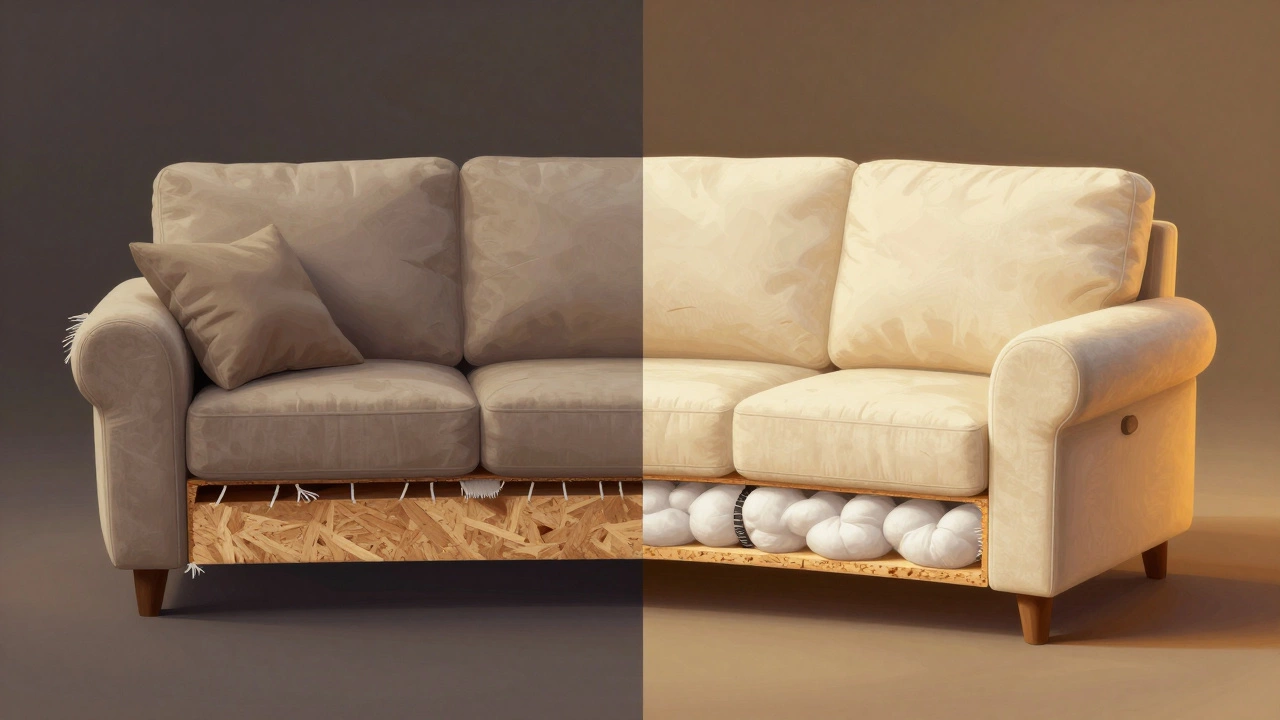
Start with the frame. Cheap sofas use glued or nailed particleboard or thin plywood. They warp over time. High-end sofas use kiln-dried hardwood like oak, beech, or maple. These are jointed with corner blocks and screwed, not just glued. You can’t see it, but you’ll feel it when the frame holds up after 15 years of daily use.
Then there’s the suspension. In budget sofas, you’ll find S-springs or cheap elastic webbing that sags after a year. Luxury sofas use eight-way hand-tied springs. Each spring is tied by hand in a grid pattern. This gives you even support, prevents sinking, and lets the cushion bounce back. It’s the same system used in 19th-century furniture-and still the gold standard today.
Fillings matter too. A £800 sofa might use low-density foam that flattens like a pancake in six months. A £2,800 sofa? It layers high-resilience foam with down feathers and polyester wadding. The result? You sink in just enough, but you don’t feel the frame. And when you stand up, it returns to shape.
How Long Do Expensive Sofas Actually Last?
Most people replace their sofa every 7 to 10 years. That’s normal. But if you buy a well-made one, you might never need to replace it.
A study by the Furniture Industry Research Association found that sofas with hardwood frames and hand-tied springs lasted an average of 22 years. Sofas with particleboard frames and elastic webbing? They lasted 5.8 years. That’s nearly four times longer.
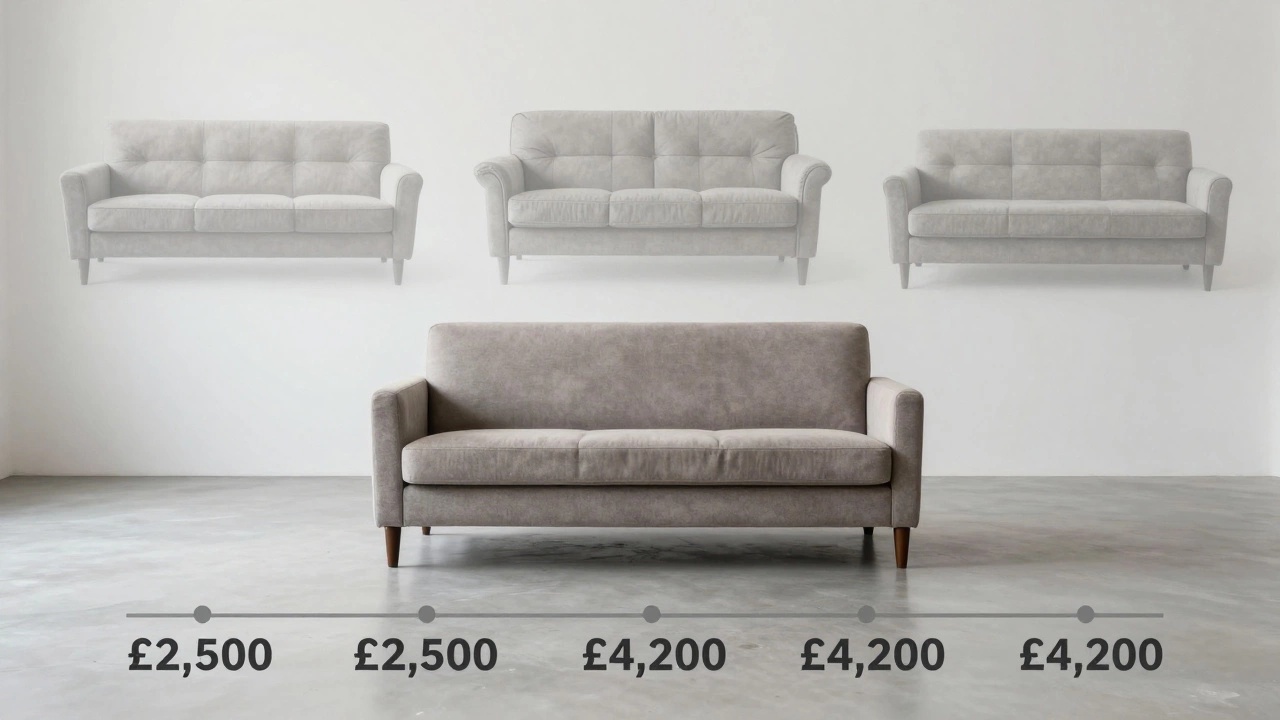
Think about it: if you spend £2,500 on a sofa that lasts 20 years, you’re paying £125 a year. A £700 sofa that lasts 6 years? That’s £117 a year. At first glance, the expensive one seems like a rip-off. But here’s the catch: the cheap one breaks, you buy another, then another. Over 20 years, you spend £4,200 on three replacements. The expensive one? One payment. No hassle. No clutter.
Who Actually Benefits from an Expensive Sofa?
It’s not about money. It’s about lifestyle.
If you have kids, pets, or a messy house? A luxury sofa with performance fabric (like Crypton or Sunbrella) is a game-changer. These materials repel spills, resist stains, and can be wiped clean with a damp cloth. You can spill red wine on it at 10 p.m. and clean it before bed. No more panic. No more covers. No more replacing the sofa every time someone brings home a muddy dog.
If you work from home? You’re probably sitting on that sofa for hours. A cheap one will make your back ache. A well-designed one supports your posture. It has the right lumbar curve, firm enough to keep you upright but soft enough to relax. It’s not a luxury. It’s health.
If you entertain often? You want guests to feel comfortable, not like they’re sitting on a pile of foam that’s been flattened by 10 people. An expensive sofa doesn’t just look good-it feels good. And people notice.
What to Look for Before You Buy
Don’t just trust the price tag. Here’s how to tell if a sofa is worth the cost:
- Check the frame-lift the sofa. If it feels heavy and solid, that’s a good sign. Shake it. If it rattles or moves, walk away.
- Test the springs-sit on it. Press down with your hand. If you feel individual springs, it’s hand-tied. If it’s all mushy, it’s elastic webbing.
- Look at the cushions-remove the covers. High-end sofas use removable, replaceable cushions. You can flip them, wash them, or even buy new ones later.
- Ask about fabric-if it’s labeled "performance fabric," "solution-dyed," or "rub test 30,000+ double rubs," it’s built to last. Anything under 15,000 double rubs? It’ll pill and fade fast.
- Check the warranty-a 10-year warranty on the frame? That’s standard for quality. A 1-year warranty? Red flag.
The Hidden Cost of Cheap Sofas
People think they’re saving money by buying cheap. But they’re not.
Think about storage. Where do you put the old sofa? A garage? A landfill? You pay for disposal. Some councils charge £50 to take it away. Then there’s the time. You spend weekends searching for replacements, measuring doorways, waiting for delivery, arguing with delivery guys who drop it on the lawn.
And then there’s the emotional cost. That sofa you bought for £599? It’s already sagging. The fabric is shiny where your dog sleeps. You avoid sitting on it because it’s uncomfortable. You feel guilty every time you look at it. You’re not just paying for furniture. You’re paying for stress.
Expensive sofas don’t just last longer. They make life easier. You don’t have to think about them. They just work.
Is It Worth It? The Bottom Line
Yes-if you care about comfort, durability, and not having to replace furniture every few years. No-if you’re buying for looks alone, or you plan to move in 3 years.
Here’s the rule: if you’re going to live in your home for more than 5 years, and you use your sofa every day, spend the extra money. You’ll thank yourself in year 7, year 12, year 18.
But don’t buy the most expensive one just because it’s labeled "luxury." Find the one with the right frame, the right springs, the right fabric. That’s where the value is. Not in the brand name. Not in the velvet. In the bones of the thing.
And if you’re still not sure? Rent one. Some high-end furniture stores now offer 6-month trials. Sit on it. Live with it. Then decide. No pressure. No commitment. Just real-world testing.
Because a sofa isn’t just a place to sit. It’s where you relax after work. Where you watch movies with your partner. Where your kids nap after school. Where your dog curls up at your feet. It’s part of your life. Shouldn’t it last as long as the memories you make on it?
Write a comment