
Office Chair Height Ergonomic Checker
Enter your measurements below to instantly check if your current chair setup is causing the "Too High" issues described in the article, such as thigh compression and lower back strain.
Your Measurements
Diagnostic Result
You sit down, adjust the lever, and feel like you're perched on a stool at a high bar. Your feet dangle, or worse, they barely touch the floor with your heels hovering in mid-air. It feels airy, maybe even powerful, but within an hour, your lower back starts to ache and your thighs feel tight. This isn't just discomfort; it's a biomechanical warning sign. When your office chair is set too high relative to your desk and body proportions, you trigger a chain reaction of postural compensations that can lead to chronic pain and long-term health issues.
Most people think ergonomics is about looking professional. In reality, it's about physics. Gravity doesn't care about your job title. If your chair height disrupts the natural alignment of your spine and hips, your muscles have to work overtime to keep you upright. Let's break down exactly what happens when you ignore the "too high" setting, how to spot the signs early, and what you can do to fix it without buying new furniture tomorrow morning.
The Immediate Physical Toll: Why Your Body Hates Being Too High
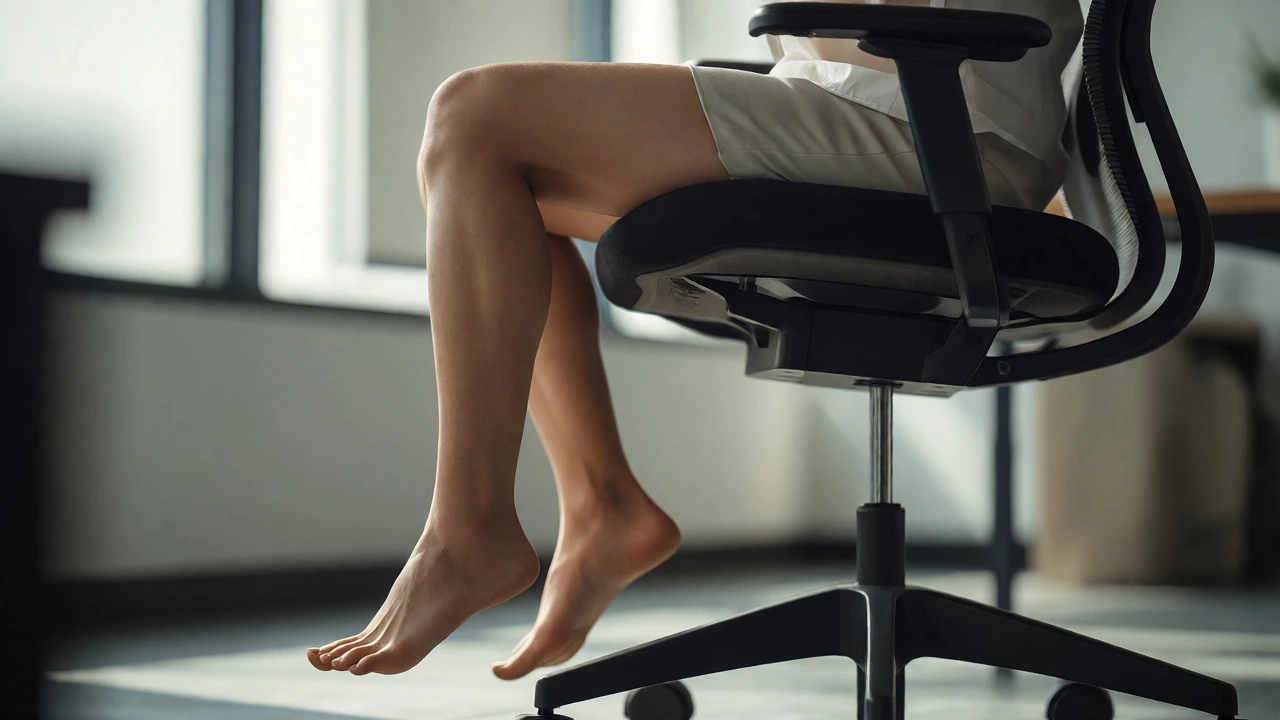
When your seat pan is higher than your popliteal fossa (the crease behind your knee), two major things happen immediately: pressure on your thighs and instability in your pelvis. You might not notice it for the first ten minutes, but by hour three, the damage is cumulative.
First, consider your legs. If your feet don't rest flat on the floor, the edge of the seat digs into the underside of your thighs. This compresses the soft tissue and restricts blood flow. We aren't just talking about pins and needles; we are talking about reduced venous return. Blood has to fight gravity to get from your legs back to your heart. When the seat cuts off this flow, you risk swelling in the ankles and feet, a condition often mistaken for simple fatigue but actually a circulatory issue. Over time, poor circulation combined with static sitting increases the risk of varicose veins and deep vein thrombosis (DVT).
| Symptom Area | Specific Sensation | Underlying Cause |
|---|---|---|
| Lower Back | Aching, stiffness, slouching | Pelvic tilt backward due to lack of foot support |
| Thighs | Numbness, tingling, coldness | Compression of femoral nerve and blood vessels |
| Shoulders/Neck | Tension headaches, shrugging posture | Raising arms excessively to reach keyboard/mouse |
| Feet | Cramping, restless movement | Inability to ground oneself properly |
The Spine Connection: How Foot Position Dictates Posture
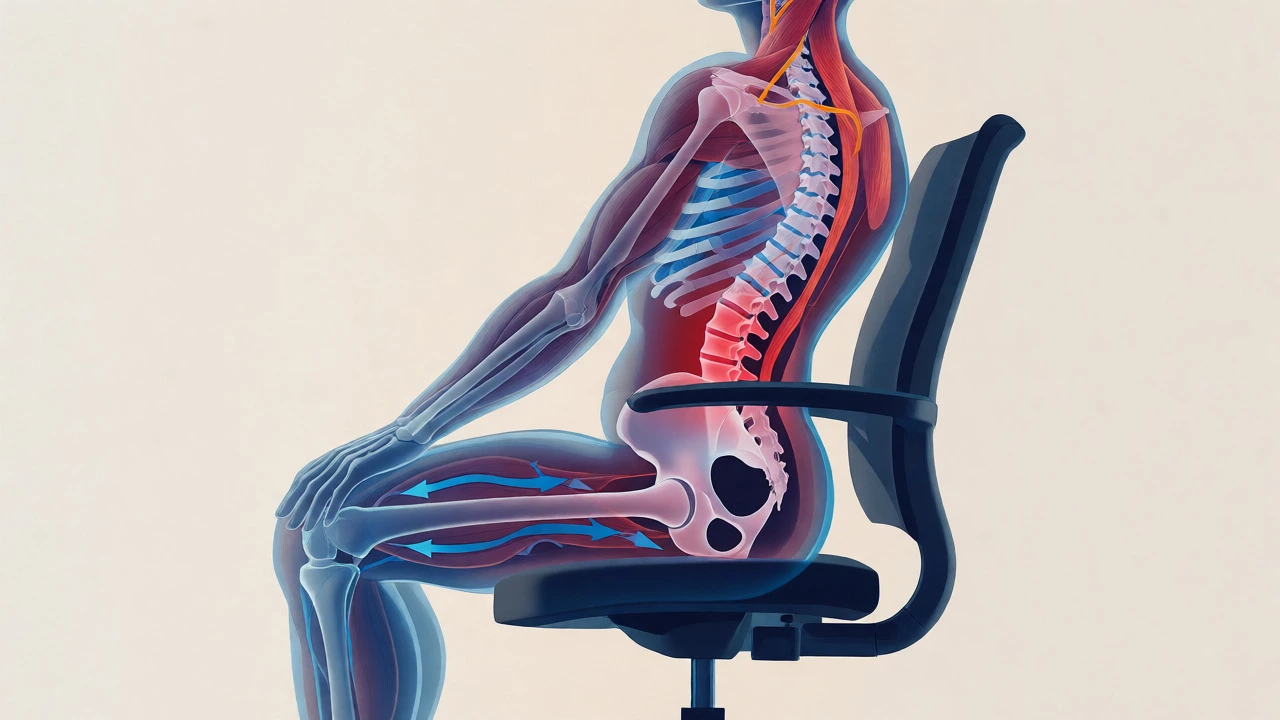
Your spine doesn't exist in isolation. It sits on top of your pelvis, which acts as a base. Think of your pelvis like a bowl of water. If you tip the bowl forward, the water spills out the front (anterior pelvic tilt). If you tip it backward, it spills out the back (posterior pelvic tilt). When your chair is too high and your feet dangle, you instinctively slide forward to find stability. This slides your pelvis backward, flattening the natural curve of your lumbar spine.
This flattened curve removes the shock-absorbing capacity of your lower back. Instead of distributing weight evenly across your intervertebral discs, all the pressure concentrates on the posterior part of the disc. This is a fast track to herniated discs. Furthermore, because you are sliding forward, you lose contact with the backrest. Without lumbar support, your core muscles must engage constantly to hold you up. Since most of us aren't trained athletes, these muscles fatigue quickly, leading to that familiar "slump" around 3 PM.
Upper Body Compensation: The Shoulder Shrug Effect
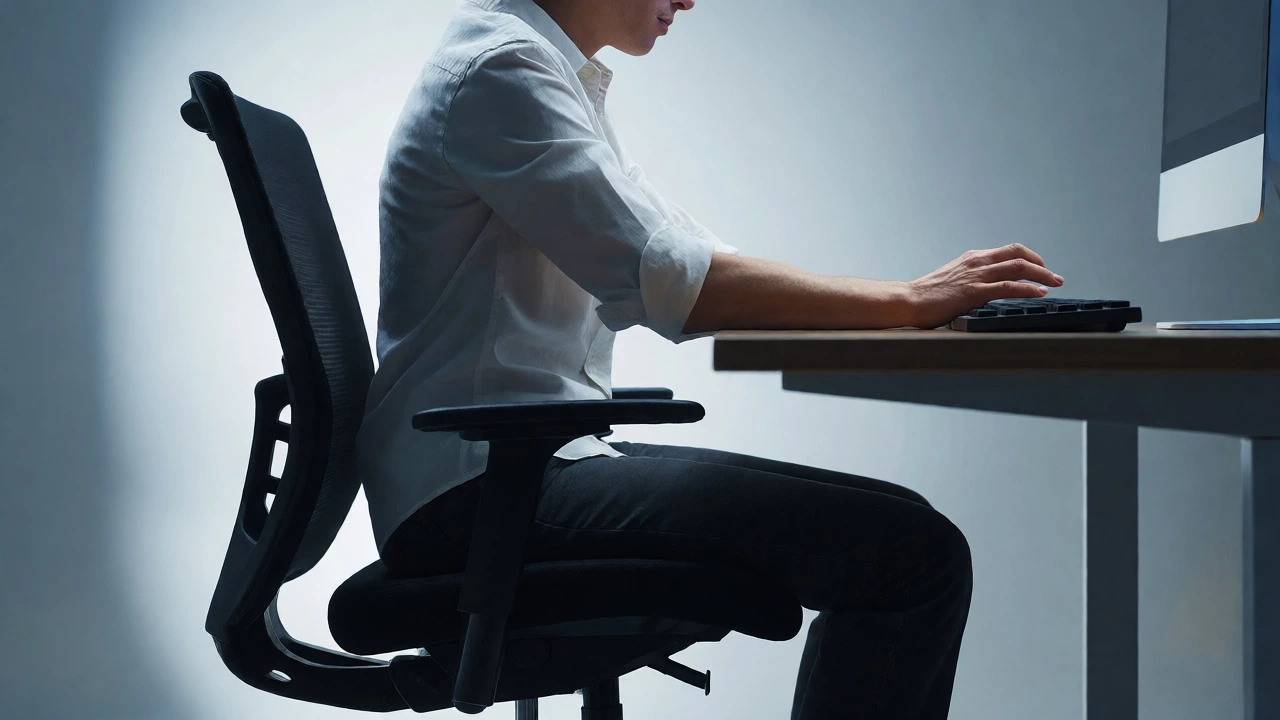
If your chair is too high, your torso rises above the optimal working plane of your desk. To compensate, you likely raise your shoulders to reach your keyboard and mouse. This is called shoulder elevation. It sounds minor, but holding your shoulders up engages the upper trapezius muscles-the ones that run from your neck to your shoulders.
Holding tension here for eight hours a day creates trigger points that refer pain directly into your head. This is a primary cause of tension headaches. Additionally, raising your elbows above the level of your wrists changes the angle of your forearm. This can compress the median nerve at the carpal tunnel, exacerbating symptoms of repetitive strain injury (RSI) or carpal tunnel syndrome. If you type frequently, a chair that is too high is essentially fighting against your wrist anatomy.
How to Check If Your Chair Is Actually Too High
You don't need a degree in occupational therapy to check your setup. Follow this quick diagnostic test right now:
- The Three-90 Rule: Sit as far back in the chair as possible. Your knees should be at a 90-degree angle (or slightly more open, up to 100 degrees), your hips at 90 degrees, and your elbows at 90 degrees when resting on the desk.
- The Two-Finger Test: Slide two fingers between the edge of the seat cushion and the back of your knee. If you can't fit them, the seat is too deep. If there is a huge gap, the seat might be too short, but if your feet are dangling, the height is definitely wrong.
- The Foot Flat Check: Can you place both feet completely flat on the floor without leaning forward? If your heels lift off the ground, the chair is too high.
- The Eye Level Check: Look straight ahead. The top of your monitor screen should be at or slightly below eye level. If you are looking down significantly, your chair might be too low. If you are craning your neck up, it might be too high relative to your desk depth.
If you fail any of these checks, your chair is misconfigured for your body geometry.
Fixing the Problem: Adjustments Before Buying New Gear
Before you spend hundreds on a new ergonomic chair, try these adjustments. Most office chairs have a gas lift mechanism, but sometimes the range isn't enough for shorter individuals or those with specific desk heights.
Use a Footrest: This is the cheapest and most effective solution. If your chair is too high to allow your feet to touch the floor while maintaining proper back support, buy a sturdy footrest. Place it under your desk so your feet can rest flat on it. This restores the 90-degree knee angle and stabilizes your pelvis. Ensure the footrest has a textured surface to prevent slipping.
Adjust Seat Depth: Some chairs allow you to slide the seat pan forward or backward. If you are tall but your chair is still too high, sliding the seat forward might help you reach the floor better, though this often compromises back support. Conversely, if you are shorter, ensure the seat isn't pushing your knees past your toes.
Modify Desk Height: If your desk is fixed and too low for your chair, you are forced to hunch. Consider a keyboard tray that mounts under the desk, allowing you to lower your typing surface independently of the main desk surface. Alternatively, use monitor stands to raise your screen if you end up lowering the chair too much.
Long-Term Consequences of Ignoring Chair Height
Short-term discomfort is annoying, but long-term neglect leads to structural changes. Chronic compression of the sciatic nerve can lead to sciatica, where pain radiates from your lower back down your leg. Poor circulation can contribute to lymphedema, causing persistent swelling in the lower limbs.
Moreover, bad posture becomes habitual. Your brain maps your body position. If you spend years sitting with a posterior pelvic tilt and rounded shoulders, your muscles adapt. Your hip flexors shorten, and your glutes weaken-a condition known as "lower crossed syndrome." Once these muscular imbalances are established, correcting them requires physical therapy, not just a new chair. The cost of treating chronic back pain far exceeds the price of a decent footrest or an adjustable chair.
Choosing the Right Chair Height Range
When shopping for a new chair, pay attention to the seat height adjustment range. Standard office chairs typically adjust from 16 to 21 inches. If you are under 5'4", you might need a chair that goes down to 15 inches or less. If you are over 6'2", look for chairs that extend to 22 inches or more.
Also, consider the material of the seat pan. A hard plastic edge digs into your thighs faster than a curved, foam-padded edge. Look for "waterfall edge" designs, where the front of the seat curves downward. This design minimizes pressure on the popliteal artery and nerve, making slight height discrepancies less painful.
Is it better for my office chair to be too high or too low?
Generally, a chair that is slightly too low is easier to correct than one that is too high. If a chair is too low, you can add a cushion to raise it. If it is too high, you often cannot easily lower it without removing the casters or wheels, which reduces mobility. However, both extremes cause harm. A too-low chair forces you to raise your shoulders to reach the desk, causing neck strain, while a too-high chair cuts off circulation and destabilizes the spine.
Can sitting in a chair that is too high cause sciatica?
Yes, indirectly. When your feet dangle, you tend to slide forward and flatten your lumbar curve. This shifts pressure onto the intervertebral discs and can irritate the sciatic nerve roots. Additionally, the direct pressure from the seat edge on the back of the thighs can compress the sciatic nerve itself, leading to shooting pain down the leg.
Do I really need a footrest if my feet don't touch the floor?
If your feet do not touch the floor, your body lacks a stable base. This forces your core muscles to work harder to maintain balance, leading to quicker fatigue. A footrest provides the necessary ground contact, allowing your pelvis to remain neutral and reducing the load on your lower back. It is a highly recommended accessory for anyone whose chair height cannot be lowered sufficiently.
How high should my knees be compared to my hips?
Ideally, your knees should be at the same level as your hips or slightly lower (hips slightly higher than knees). This opens up the hip angle to about 90-100 degrees, which supports the natural curve of the lower back. If your knees are significantly higher than your hips, your chair is too low. If your knees are significantly lower, your chair is too high.
Does chair height affect productivity?
Absolutely. Discomfort is a distraction. Studies on workplace ergonomics show that employees with properly adjusted chairs report fewer breaks due to pain and higher focus levels. When you are not constantly shifting to relieve thigh pressure or stretching a stiff neck, you can maintain deep work states longer.
Write a comment