
American vs. British English Storage Translator
Type a word or phrase related to clothes storage (e.g., "wardrobe," "closet," "armoire") to see how it translates between regions.
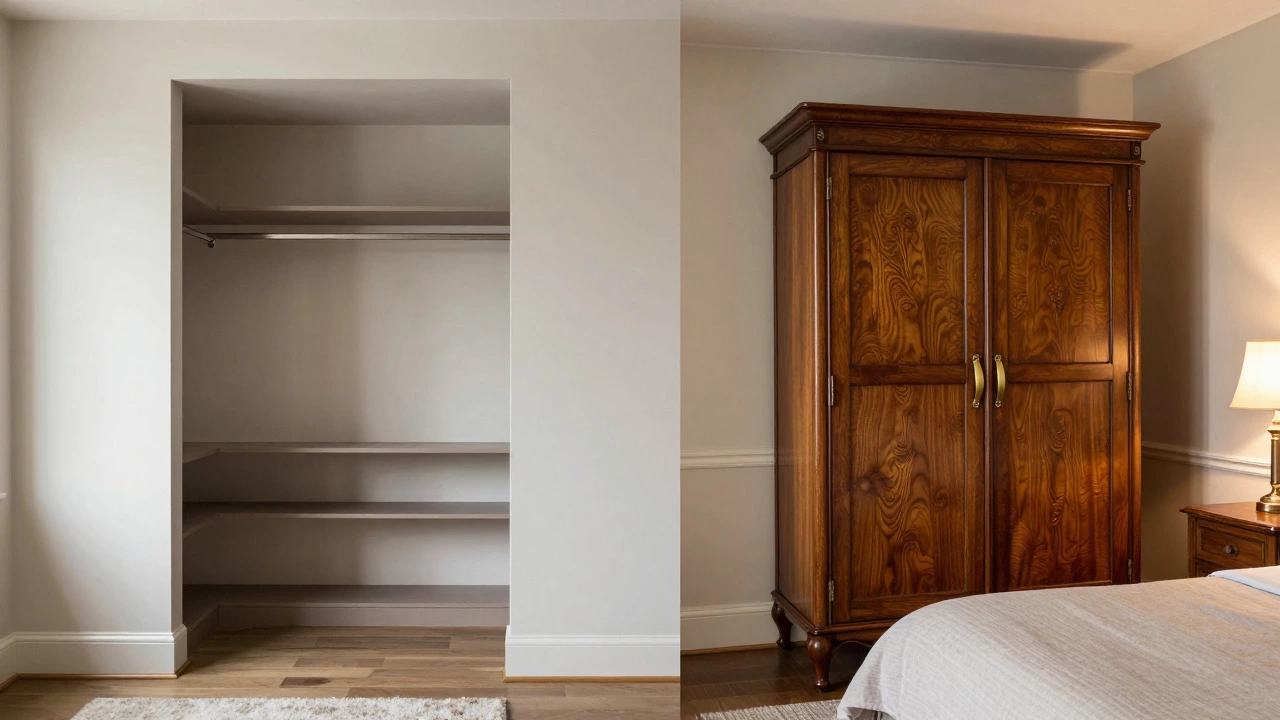
You walk into a bedroom in New York, and you see clothes hanging inside the wall. You walk into a bedroom in London, and you see a tall wooden cabinet standing against the wall. Both are used to store clothes. But if you ask an American what they call that piece of furniture, you might get confused. The short answer is: wardrobe exists in American English, but it means something very different than it does in British English.
If you are trying to buy furniture or understand a TV show, this distinction matters more than you think. In the US, the word "wardrobe" rarely refers to the built-in storage space where most people keep their shirts and pants. Instead, Americans use the word "closet." If you want to buy a standalone piece of furniture to hold your clothes, you might hear the words "armoire" or "dresser," depending on whether the clothes hang up or fold flat. Let’s break down exactly how these terms work so you never feel lost again.
The Core Difference: Closet vs. Wardrobe
In British English, a "wardrobe" is almost always a large, tall cupboard with doors, designed to hang clothes in. It is a piece of furniture you can move from one house to another. In American English, the primary place for hanging clothes is not a piece of furniture at all. It is a room or a compartment built into the walls of the house. This is called a built-in closet.
When an American says, "I’m going to clean out my wardrobe," they usually mean they are organizing the contents of their closet. However, if they say, "I bought a new wardrobe," they likely mean they purchased a collection of clothing, not a piece of wood. This double meaning is the biggest source of confusion. To avoid ambiguity, Americans specify. They say "closet" for the storage space and "clothing" or "outfits" for the garments themselves.
| Concept | British English Term | American English Term |
|---|---|---|
| Built-in wall storage for hanging clothes | Wardrobe / Cupboard | Closet |
| Standalone furniture for hanging clothes | Wardrobe | Armoire / Dresser (if drawers) |
| Collection of clothes owned by a person | Wardrobe | Wardrobe / Clothing / Outfits |
| Small shelf unit for shoes/accessories | Shoe rack / Drawer unit | Shoe rack / Organizer |
Why Do Americans Use "Closet"?
The reason for this difference comes down to architecture, not just language. In many older European homes, especially in the UK, houses were smaller, and building recesses into load-bearing walls was difficult or expensive. People needed portable storage solutions. A wooden wardrobe was practical because you could carry it when you moved. It became the standard term for any large container for clothes.
In the United States, particularly as suburbs expanded in the mid-20th century, home construction changed. Houses became larger, and builders started incorporating dedicated spaces for storage directly into the floor plan. These spaces, often lined with plywood or drywall and fitted with rods and shelves, became known as closets. Because every bedroom in a typical American home has a closet, the need for a standalone wardrobe diminished significantly. The word "closet" stuck because it describes the location, not the object.
This architectural shift also influenced vocabulary. An American might refer to a "walk-in closet," which is essentially a small room dedicated entirely to storage. There is no direct British equivalent for this specific concept because the traditional wardrobe doesn’t offer enough space to walk into. When Americans describe their storage, they focus on the size and accessibility of the space, leading to terms like "reach-in closet" or "hall closet."
When Do Americans Say "Wardrobe"?
Even though "closet" is the go-to word for storage, "wardrobe" is still widely used in America. You just have to know the context. Here are the three main scenarios where an American will use the word:
- Fashion and Retail: If you work in fashion, you talk about a client's "wardrobe" as their entire collection of clothes. A stylist might say, "We need to refresh your winter wardrobe." Here, the word refers to the abstract concept of ownership, not the physical box holding the items.
- Theater and Film: In entertainment, the "wardrobe department" manages costumes. Actors don’t keep their stage clothes in a closet; they check them out from the wardrobe master. This usage is identical in both American and British English.
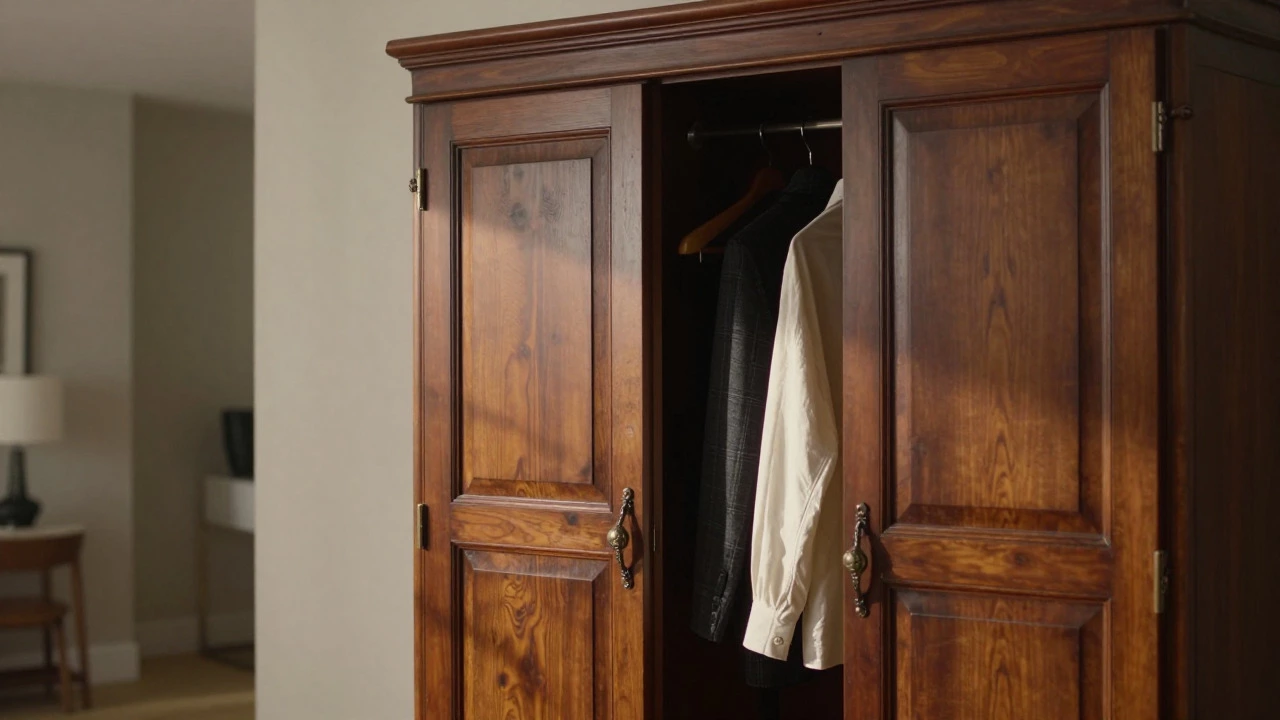
- High-End Furniture: If an American buys a standalone piece of furniture for clothes, they rarely call it a wardrobe unless they are being pretentious or quoting a catalog. More commonly, they call it an armoire. An armoire is a freestanding cabinet, often ornate, used for hanging clothes. It is the closest functional equivalent to the British wardrobe, but the word "armoire" signals a specific style-usually vintage, French-inspired, or heavy wood.
There is also the phrase "wardrobe malfunction," which entered popular culture after a famous Super Bowl incident in 2004. This refers to an accidental exposure of underwear or skin due to clothing failure. No American would say "closet malfunction" in this context. The word retains its association with the clothing itself, not the storage.
Armoire vs. Dresser: The Standalone Options
If you live in an apartment without a closet, or if you need extra storage, you have to buy furniture. This is where the terminology gets tricky. Many people assume "wardrobe" is the generic term for any big clothes cabinet, but Americans make a sharp distinction based on how the clothes are stored.
An armoire is vertical. It has doors that open outward, and inside, there is a rod for hanging jackets, dresses, and pants. It looks like a mini-closet. If you search for "wardrobe" on Amazon or Wayfair in the US, you will mostly find armoires. Sellers use the word "wardrobe" because it sounds more sophisticated than "big wooden box," but customers usually read the description to confirm it has a hanging rod.
A dresser, on the other hand, is horizontal. It consists of drawers. You do not hang clothes in a dresser; you fold them. In British English, a dresser might be part of a "bedroom suite" along with a chest of drawers, but in the US, "dresser" is the dominant term for any drawer-based storage. If you tell an American friend you bought a "wardrobe," and they come over to see a set of six deep drawers, they will correct you: "That’s a dresser."
Then there is the chest of drawers. This is similar to a dresser but often taller and narrower. Some people use "dresser" and "chest of drawers" interchangeably, but purists argue that a dresser is wider and meant to have a mirror or vanity top, while a chest is purely for storage. Regardless of the nuance, neither is a wardrobe in the British sense.
Regional Variations and Slang
Language isn’t static, and even within the US, there are slight variations. In some parts of the South, you might hear the word "cupboard" used for a closet, though this is fading. "Cupboard" traditionally referred to a small storage space for dishes or food, but older generations sometimes applied it to any enclosed storage area.
In urban areas like New York City, where apartments are tiny and closets are non-existent, the word "closet" is often replaced by "storage" or "locker." Tenants might complain, "My apartment has no closet," meaning there is no designated space for clothes at all. In these cases, residents rely heavily on armoires, garment bags, or under-bed storage solutions. The lack of built-in infrastructure makes the distinction between furniture and architecture even more critical.
Also, consider the word "hamper." While not a direct synonym for wardrobe, it is part of the same ecosystem. A hamper is a basket for dirty laundry. In the UK, you might put clothes in a "laundry basket." In the US, "hamper" is the standard term. It connects to the idea of the closet cycle: clothes come out of the closet, go into the hamper, get washed, and return to the closet. Understanding this loop helps clarify why the closet is central to American domestic life.
How to Order Furniture Without Confusion
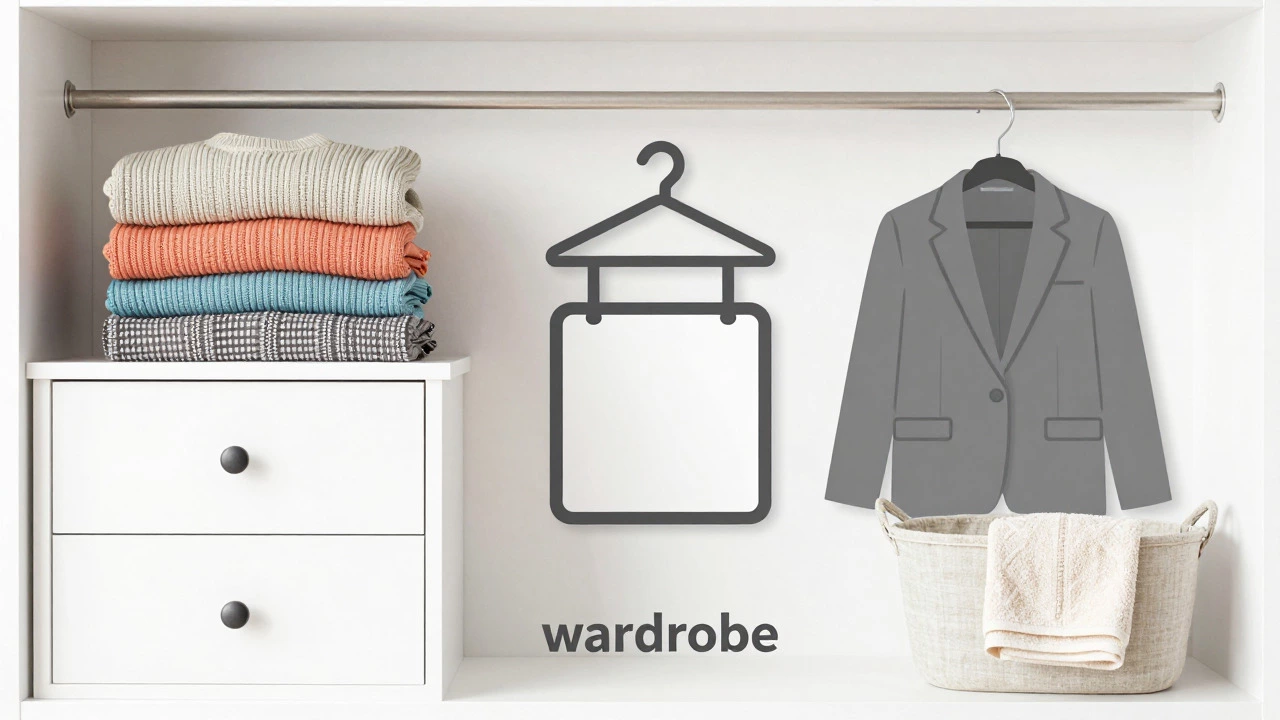
If you are shopping online or talking to a salesperson, clarity is key. Here is a quick guide to getting what you actually want:
- If you want to hang clothes: Search for "armoire" or "hanging closet organizer." Avoid just searching "wardrobe" unless you filter by "hanging rod" in the results. Specify "freestanding" to ensure it’s not a built-in kit.
- If you want to fold clothes: Search for "dresser" or "chest of drawers." Look for dimensions that match your folded sweaters and jeans. Note that dressers come in configurations like 6-drawer, 8-drawer, or 9-drawer.
- If you want a combination: Look for "dresser with hutch" or "combo unit." These pieces have drawers on the bottom and a hanging section or shelves on top. They mimic the functionality of a British wardrobe but are marketed differently in the US.
Always check the material. American-made wardrobes (armoiries) are often made of particle board or MDF (medium-density fiberboard) because solid wood is expensive. If you want durability, look for "solid wood armoire" or "oak wardrobe." Be wary of cheap imports that may fall apart if overloaded. The structural integrity of a freestanding wardrobe depends on its back panel and internal supports, which are often thinner in budget models.
Common Mistakes to Avoid
One common mistake is assuming that "wardrobe" implies quality. In the UK, a well-made wardrobe is a status symbol. In the US, because closets are standard, standalone wardrobes are seen as temporary solutions or decorative accents. Don’t expect an American "wardrobe" to be as robust as a British one unless you pay a premium for custom craftsmanship.
Another mistake is mixing up "linen closet" with "clothes closet." A linen closet stores sheets, towels, and blankets. It is usually found in the hallway or bathroom, not the bedroom. It is shallow and has shelves, not hanging rods. If you buy a wardrobe thinking it will fit in a narrow hallway, measure carefully. Armoires are wide and deep; they need significant floor space.
Finally, don’t forget about lighting. Built-in closets often have poor lighting. When buying a standalone armoire, consider adding battery-operated LED strips inside. This small upgrade transforms a dark wooden box into a functional, modern storage solution. It bridges the gap between the convenience of a built-in closet and the flexibility of furniture.
Is "wardrobe" an outdated word in America?
No, it is not outdated, but its usage is specific. Americans use "wardrobe" to describe their collection of clothes or in professional contexts like theater. For furniture, they prefer "armoire" or "closet." Using "wardrobe" to refer to a piece of furniture won’t confuse anyone, but it may sound slightly formal or imported.
Can I use "cupboard" instead of "closet"?
In most of the US, "cupboard" refers to kitchen storage for dishes or food. Using it for clothes might confuse people. Stick with "closet" for bedrooms and hallways. "Cupboard" is more common in Southern dialects or among older generations, but it is not the standard term nationwide.
What is the difference between an armoire and a wardrobe?
Functionally, they are the same: a standalone cabinet for hanging clothes. The difference is linguistic and stylistic. "Armoire" is the preferred American term for this furniture, often implying a decorative, vintage, or French design. "Wardrobe" is the British term. In the US, sellers may use both words interchangeably in product titles to capture search traffic.
Do all American homes have closets?
Most modern American homes do have closets in bedrooms and bathrooms. However, older homes, particularly those built before the 1950s, or small city apartments, may lack them. In these cases, residents must buy standalone furniture like armoires or dressers to store their clothes.
Why do British people call it a wardrobe?
Historically, British homes were smaller and less likely to have built-in storage niches. Furniture had to be portable. The wardrobe evolved as a large, movable cupboard. Since the architecture didn’t change to include built-in closets, the term "wardrobe" remained the standard for any large clothes storage unit.
Write a comment