
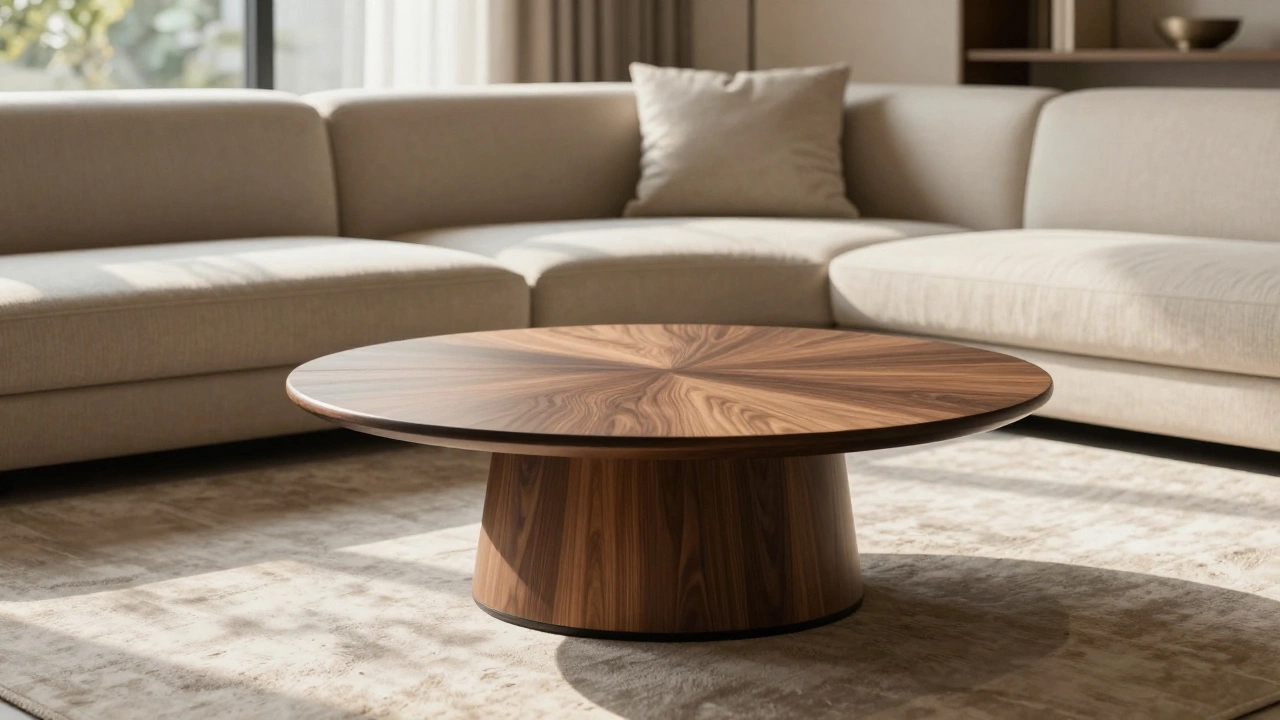
Round Coffee Table Sizing & Placement Calculator
Room Dimensions
Visual Preview & Analysis
Picture this: you’ve just bought that beautiful, sleek round coffee table. It looks stunning in the showroom. But when you wheel it into your living room and place it in front of your sofa, something feels... off. Is it too far? Too close? Does it look like an island lost at sea?
You are not alone. The debate over whether a round coffee table works in front of a sofa is one of the most common questions in interior design. Some swear by the softness of curves; others insist only rectangles make sense against straight lines. The truth? It depends entirely on how you measure, space, and style it.
This guide cuts through the noise. We will look at the geometry, the safety factors, and the aesthetic rules that determine if your round table will be a hit or a miss. By the end, you’ll know exactly where to place it and why.
The Geometry of Comfort: Why Shape Matters
Let’s start with the basics. Why do we usually see rectangular tables in front of sofas? It’s about alignment. Most sofas have a long, horizontal silhouette. A rectangular table mirrors that shape, creating a visual line that leads the eye across the room. It feels grounded and intentional.
A Round coffee table is a circular surface supported by a central pedestal or multiple legs, designed to soften angular spaces. When you place a circle in front of a rectangle, you break that linear flow. This isn’t necessarily bad-it can add warmth and approachability-but it requires more careful planning. If the table is too small, it looks like a coaster. If it’s too large, it blocks movement. The key is finding the balance point where the shape complements rather than competes with the sofa.
Think of your living room as a conversation pit. A round table naturally encourages people to gather around it from all sides. In a formal setting with a single sofa facing a TV, this might feel disjointed. In a lounge area with sectional seating or armchairs flanking the sofa, a round table becomes the perfect anchor for social interaction.
Sizing Rules: How Big Should It Be?
Size is the biggest factor in making a round table work. There is no single "correct" diameter, but there are reliable rules of thumb used by professional designers.
- The Two-Thirds Rule: The diameter of your round table should be roughly two-thirds the length of your sofa. If your sofa is 84 inches (7 feet) wide, aim for a table with a diameter between 40 and 56 inches.
- The Clearance Gap: You need breathing room. Leave 12 to 18 inches of space between the edge of the sofa cushion and the edge of the table. Less than 12 inches makes it hard to get up without hitting your knee. More than 18 inches makes reaching for a drink awkward.
- Height Harmony: The table height should match or sit slightly below the seat height of your sofa. If your sofa seats are 18 inches high, a table that is 16 to 18 inches tall creates a comfortable ergonomic level for resting arms and placing items.
If you ignore these metrics, the relationship between the furniture pieces breaks down. A tiny 30-inch table in front of a massive 90-inch sectional will look lost. Conversely, a huge 60-inch table in a tight apartment hallway will create a tripping hazard. Measure twice, buy once.
Safety First: The Sharp Corner Advantage
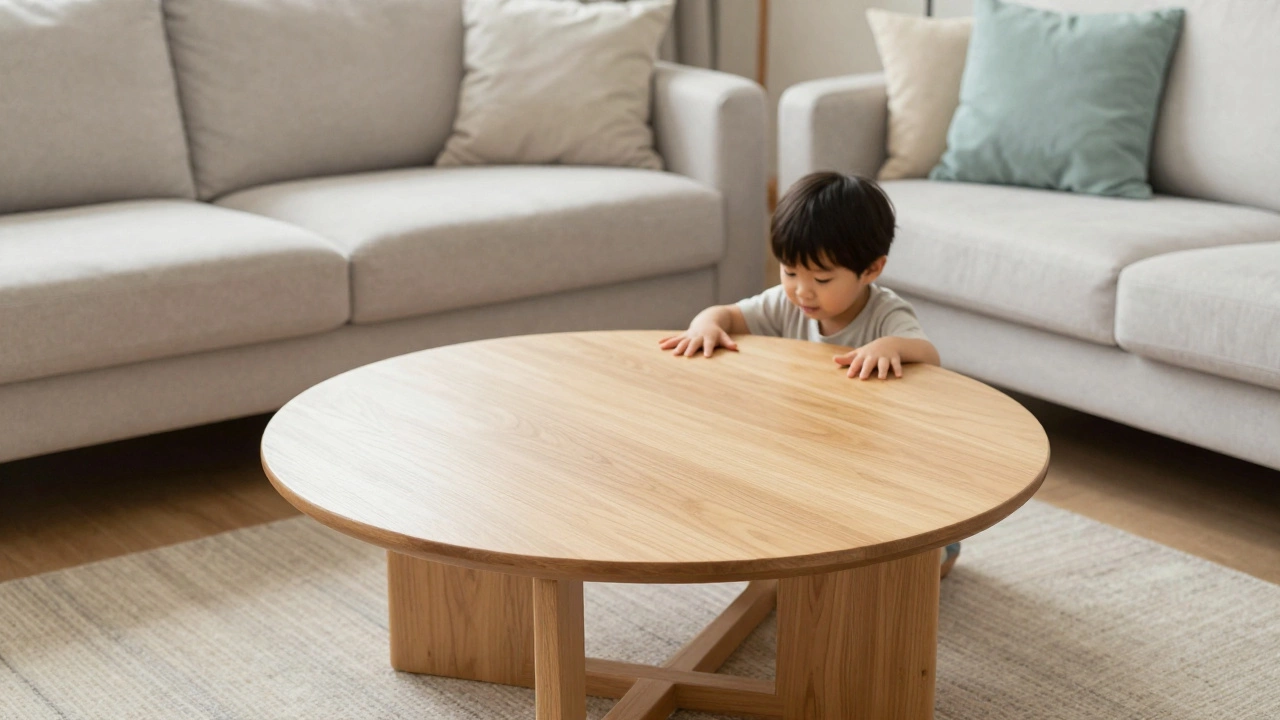
Here is the strongest argument for choosing a round table: safety. Rectangular tables have corners. Sharp, wooden, glass, or metal corners that catch shins, knees, and elbows. If you have young children running around, or if you live in a high-traffic home where people walk behind the sofa frequently, a round table is a lifesaver.
In open-plan living rooms, where the sofa might not be pushed firmly against a wall, traffic flows around the seating area. A round table eliminates the "shin-banger" effect. This is particularly important in homes with toddlers who are learning to walk or elderly family members who may move less steadily. The smooth curve allows for easier navigation around the perimeter without accidental collisions.
However, consider the material. A heavy marble round table offers stability but can cause serious injury if bumped into. A lighter wood or upholstered base might be safer for impact but could tip if leaned on heavily. Choose materials that fit your household’s activity level.
Visual Flow: Making Curves Work with Lines
Design is about balance. If your entire room is filled with sharp angles-rectangular rug, square ottoman, linear bookshelves-a round table introduces necessary contrast. It softens the visual hardness of the space. This technique is called "softening the edges," and it prevents a room from feeling sterile or corporate.
On the flip side, if your room already has lots of curves-an oval mirror, arched doorways, curved sofas-adding a round table might make the space feel too uniform. In such cases, a rectangular or square table provides the needed structure. The goal is variety, not monotony.
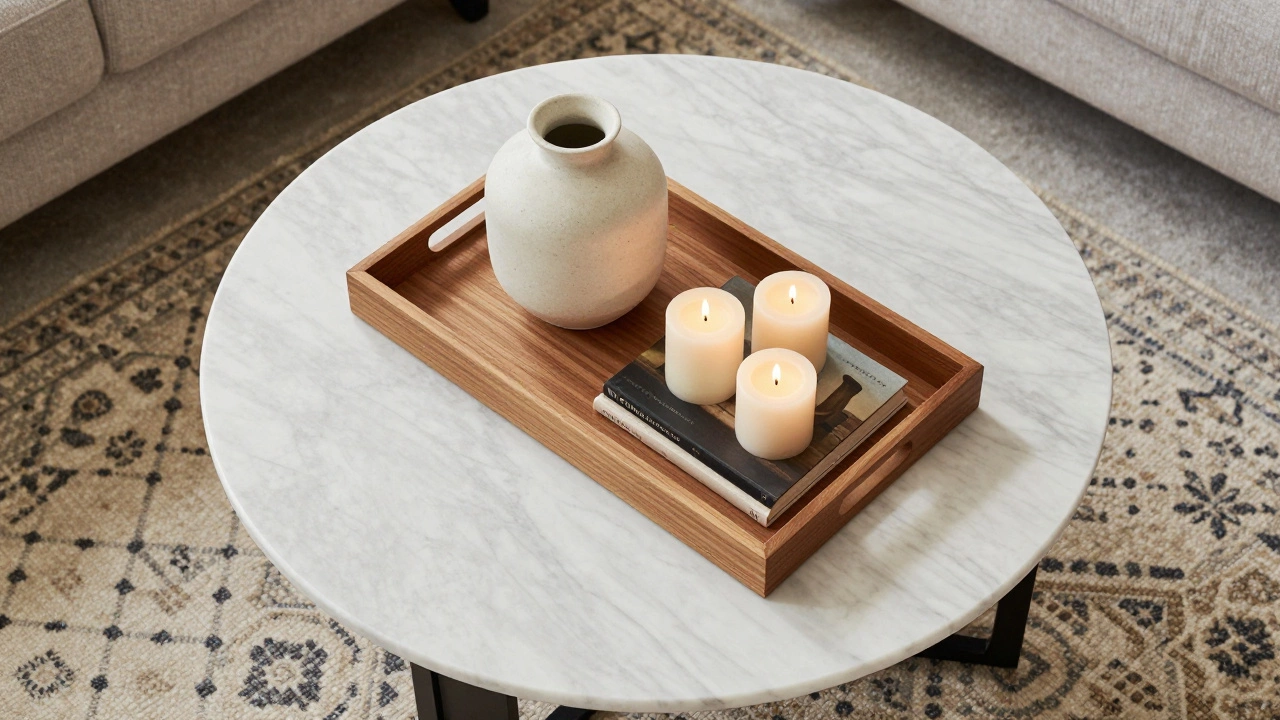
To help the round table integrate with a rectangular sofa, use accessories to bridge the gap. Place a rectangular tray on top of the round table. Arrange books in a stack that creates a vertical line. These elements introduce subtle linear cues that tie the table back to the sofa’s shape, creating a cohesive look.
| Feature | Round Coffee Table | Rectangular Coffee Table |
|---|---|---|
| Safety | High (no sharp corners) | Low (risk of shin injuries) |
| Space Efficiency | Good for narrow hallways | Requires more width clearance |
| Visual Alignment | Breaks linear flow | Matches sofa length perfectly |
| Conversation Style | Encourages gathering from all sides | Best for face-to-face seating |
| Surface Area | Less usable edge space | More usable edge space for drinks/books |
Placement Strategies: Where Exactly Does It Go?
Placing a round table isn’t just about dropping it in the middle. Its position dictates the function of the room.
- Centered Anchor: Place the table directly in front of the sofa, centered along its axis. This is the classic look. Ensure the distance from the sofa is consistent on both ends. Use a rug to define this zone. The rug should be large enough so that all four legs of the sofa (or at least the front two) rest on it, and the table sits fully within the rug’s boundaries.
- Nesting Approach: If one large round table feels too bulky, try nesting two smaller round tables. One can be placed closer to the sofa for easy access, while the other sits slightly further out. This adds visual interest and flexibility. You can pull them apart for parties or push them together for daily use.
- Off-Center Accent: In asymmetric layouts, place the round table slightly off-center. This works well if you have an armchair or a floor lamp on one side of the sofa. It creates a dynamic, lived-in feel rather than a staged showroom look.
Always check sightlines. Stand up from the sofa. Can you see past the table to the other side of the room? If the table blocks your view of the TV or the window, it might be too large or positioned too low. Adjust accordingly.
Styling Tips: Decorating a Circular Surface
Decorating a round table presents unique challenges. Items tend to slide toward the center due to gravity and lack of corners to anchor them. Here is how to keep your styling secure and stylish.
- Use a Tray: A rectangular or square tray acts as a foundation. It keeps coasters, candles, and remotes organized and prevents them from sliding off the curved edge. It also adds a layer of texture and color.
- Central Focal Point: Place a vase, a bowl, or a sculptural object in the dead center. This draws the eye inward and stabilizes the composition. Avoid placing multiple small items scattered randomly, which can look cluttered on a circular surface.
- Layering Textures: Combine materials. If your table is wood, add a ceramic vase and a linen napkin. If it’s glass, add a woven basket underneath for storage and a metallic candle holder on top. Contrast keeps the eye engaged.
- Keep Edges Clear: Reserve the outer rim of the table for functional items like drinks or remote controls during use. Keep decorative items toward the center to maximize usable space.
Common Mistakes to Avoid
Even with good intentions, it’s easy to go wrong. Here are the pitfalls that turn a great idea into a design disaster.
Mistake 1: Ignoring Traffic Flow. Don’t place a large round table in a pathway. People need at least 30 inches of clear walking space around any furniture piece. If your living room is narrow, a round table might force people to step over it or squeeze past uncomfortably.
Mistake 2: Mismatched Scale. As mentioned, scale is critical. A petite table in a grand room looks cheap. A massive table in a cozy nook feels oppressive. Always visualize the footprint before buying. Use painter’s tape on the floor to mark the circle’s diameter.
Mistake 3: Forgetting the Rug. A floating table without a rug underneath can look disconnected. The rug ties the sofa and table together into a single unit. Without it, the table appears to be drifting away from the seating area.
Mistake 4: Overcomplicating the Base. Simple bases work best. Pedestal bases offer maximum legroom and ease of cleaning. Complex multi-leg designs can look cluttered, especially under a round top. Stick to clean lines for a timeless look.
Final Thoughts: Trust Your Space
So, can you put a round coffee table in front of a sofa? Absolutely. But it won’t work automatically. It requires attention to size, spacing, and context. If you prioritize safety, want to soften a rigid room, or have a compact layout, a round table is an excellent choice. If you need maximum surface area for dining or working, or if your room is strictly linear, you might prefer a rectangle.
Experiment. Move things around. Live with the arrangement for a few days. Notice how you interact with the space. Do you bump into it? Do you struggle to reach your coffee? Adjust until it feels right. Design isn’t about following rigid rules; it’s about creating a space that works for your life.
How far should a round coffee table be from the sofa?
Ideally, leave 12 to 18 inches of space between the edge of the sofa cushions and the edge of the round coffee table. This gap ensures comfortable seating and easy access to items on the table without straining or bumping your legs.
Is a round coffee table better for small spaces?
Yes, round coffee tables often work better in small or narrow spaces because they lack sharp corners that can obstruct pathways. Their circular shape allows for smoother traffic flow around the seating area, reducing the risk of accidents and making the room feel more open.
What size round coffee table fits a 7-foot sofa?
For a 7-foot (84-inch) sofa, choose a round coffee table with a diameter between 40 and 56 inches. This follows the two-thirds rule, ensuring the table is proportional to the sofa without overwhelming the space or looking too small.
Can I use a round coffee table in a formal living room?
While rectangular tables are traditional for formal settings, a round table can add elegance and softness. To maintain formality, choose a table with refined materials like polished wood, marble, or brass, and style it minimally with high-end decor items.
Do I need a rug under a round coffee table?
It is highly recommended. A rug anchors the seating area, tying the sofa and coffee table together visually. For a round table, an oval or rectangular rug works well, ensuring the table sits fully within the rug’s boundaries while allowing the sofa’s front legs to rest on it.
Write a comment