
Coffee Table Distance Calculator
Find Your Perfect Spacing
Enter your details below to get personalized recommendations.
Your Results
Distance Recommendation
Ideal Range: --
Your Status: --
Height Alignment
Difference: --
Verdict: --
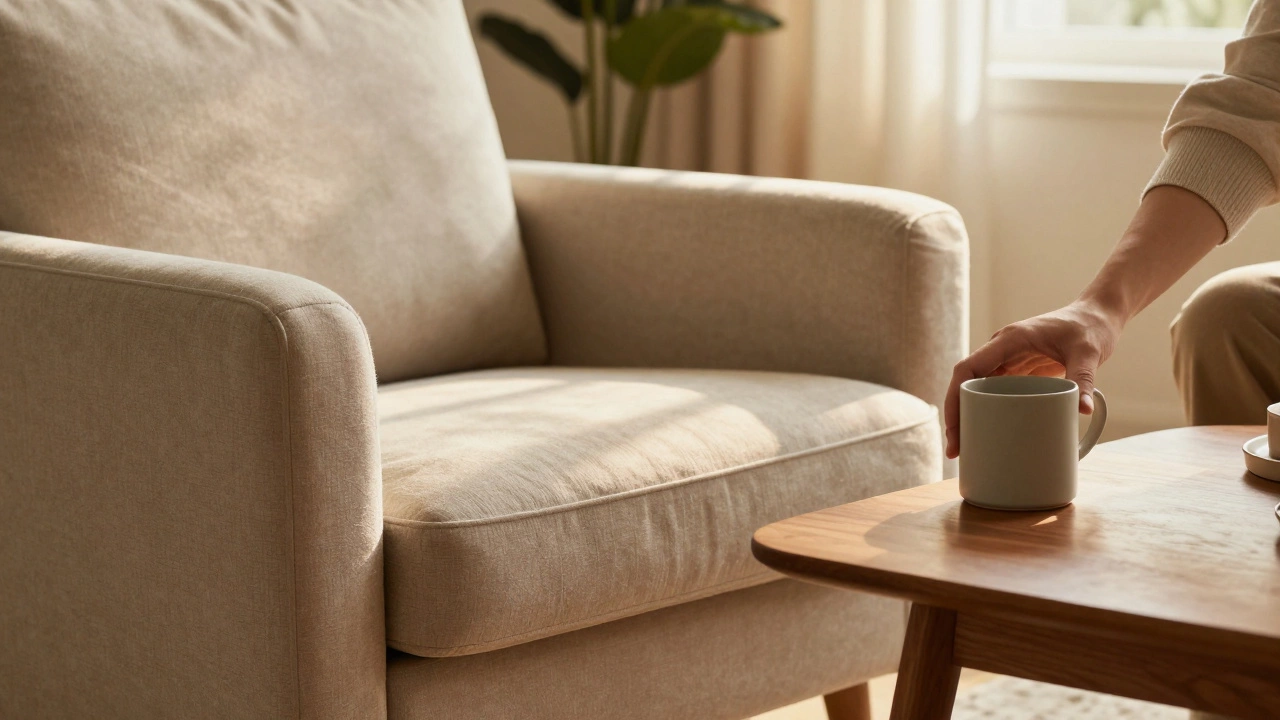
Picture this: You’re settling into your favorite armchair for some evening reading. You reach out for a drink on the coffee table, but it’s just out of reach. Or worse, you kick it every time you shift your legs. It’s frustrating, right? Getting the distance between your chair and coffee table wrong can ruin the entire vibe of your living room. It’s not just about looks; it’s about how you actually live in that space.
The short answer? Aim for 14 to 18 inches between the front edge of your sofa or chair and the nearest edge of the coffee table. This sweet spot allows you to rest your feet comfortably while keeping drinks and remotes within easy reach. But like most things in home decor, it depends on the size of your furniture and how you use the room. Let’s break down exactly how to get this right so your living room feels balanced, functional, and inviting.
The Golden Rule: 14 to 18 Inches
Interior designers often stick to a specific range when arranging seating around a central table. The standard recommendation is 14 to 18 inches. Why this range? It’s based on human ergonomics. If the gap is smaller than 14 inches, your knees might bump against the table, making it uncomfortable to sit back. If it’s wider than 18 inches, you’ll have to lean forward awkwardly to grab a coaster or a snack, which defeats the purpose of relaxing.
This rule works best for average-sized furniture. Think of a typical three-seater sofa paired with a medium-sized rectangular coffee table. The 16-inch midpoint is usually the safest bet. It gives enough breathing room for your legs while maintaining a visual connection between the pieces. When the furniture feels connected, the room feels cohesive. When there’s too much empty space, the room feels scattered and cold.
| Furniture Scale | Recommended Gap | Best For |
|---|---|---|
| Small (Apartment/Studio) | 12-14 inches | Tight spaces, compact chairs |
| Medium (Standard Living Room) | 14-18 inches | Most sofas and sectionals |
| Large (Oversized Sectionals) | 18-24 inches | Deep seats, large families |
Why Height Matters Just as Much as Distance
Distance isn’t the only factor. The height of your coffee table relative to your chair plays a huge role in comfort. A common mistake is pairing a low-profile sofa with a tall, chunky coffee table. It looks disjointed and makes reaching for items difficult. Ideally, the top of your coffee table should be level with the seat cushions of your sofa or chair. If it’s slightly lower, that’s fine. If it’s higher, it becomes an obstacle rather than a surface.
Let’s look at the numbers. Most standard sofa seats are about 17 to 19 inches high. Therefore, a coffee table that is 16 to 18 inches tall is perfect. This alignment ensures that when you’re sitting back, your arms rest naturally on the table without lifting your shoulders. It also creates a clean horizontal line across the room, which is visually pleasing. If you have a deep, plush sectional with thick cushions, the seat height might drop to 15 inches. In that case, a lower coffee table (around 14-15 inches) will feel more proportional.
Adjusting for Small Spaces
Living in a small apartment or studio? You might think the 14-inch rule doesn’t apply to you. Actually, it does, but you need to be strategic. In tight spaces, every inch counts. You can reduce the gap to 12 inches if necessary, but don’t go lower. Anything less than 12 inches feels cramped and makes it hard to stand up without hitting the table.
To make a small gap work, choose a coffee table with a smaller footprint. A round or oval table is excellent here because it lacks sharp corners. Corners take up visual and physical space, making a narrow gap feel even tighter. A round table also encourages movement around the room, which is great for flow in small areas. Additionally, consider a nesting table set. These allow you to pull one table closer when you need surface space and tuck them away when you want more legroom.
Handling Large Rooms and Sectionals
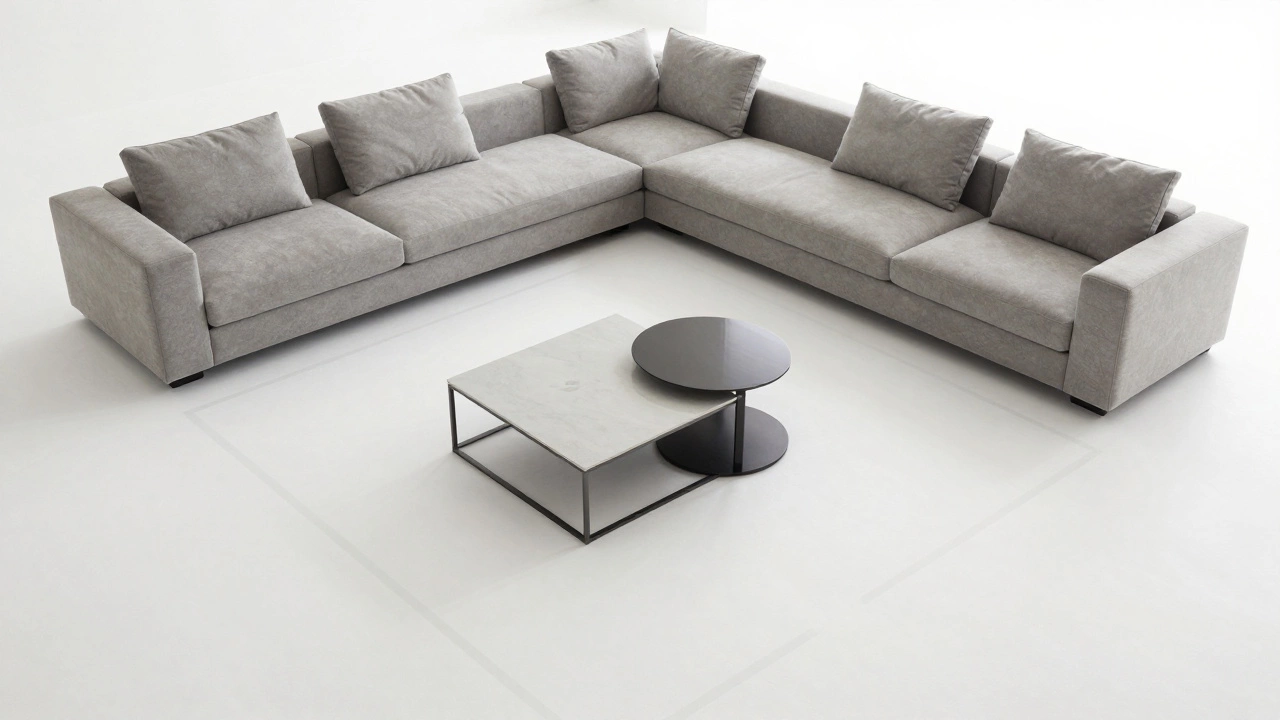
On the flip side, if you have a sprawling open-plan living area or a massive L-shaped sectional, the 14-inch gap might feel too close. In large rooms, furniture needs more air around it to avoid looking cluttered. You can increase the distance to 20 or even 24 inches. However, if you do this, you need to compensate with a larger coffee table. A tiny table in the middle of a wide gap looks lost and insignificant.
If your sectional is very deep, people sitting in the middle might find the standard coffee table too far away. Consider using two smaller tables instead of one large one. Place one near the main seating area and another near the chaise lounge. This distributes the functionality and ensures everyone has access to a surface without stretching. It also breaks up the monotony of a single large piece and adds visual interest.
Visual Balance and Proportion
Beyond comfort, there’s the aesthetic aspect. Your coffee table shouldn’t dominate the seating area, nor should it disappear. A good rule of thumb is that the coffee table should be about two-thirds the length of your sofa. If your sofa is 84 inches long, aim for a coffee table that is 56 inches long. This proportion keeps the eye moving smoothly from one piece to the other.
When arranging the pieces, step back and look at the negative space. Does the gap feel consistent on all sides? If you have chairs arranged around the table, try to maintain similar distances on each side. Symmetry isn’t mandatory, but balance is. If one side has a 14-inch gap and the other has a 24-inch gap, the room will feel lopsided. Use painter’s tape on the floor to mark the positions before moving heavy furniture. It helps you visualize the layout without the hassle of rearranging everything multiple times.
Common Mistakes to Avoid
One frequent error is ignoring traffic flow. While 14 to 18 inches is ideal for sitting, you also need space to walk behind the sofa and chairs. Ensure there’s at least 30 to 36 inches of clearance behind the seating for people to pass through comfortably. If your room is narrow, you might need to sacrifice some legroom in front to accommodate walking space behind. Prioritize safety and movement over strict adherence to the front-gap rule.
Another mistake is choosing a table that’s too bulky for the gap. Even if the distance is correct, a thick, heavy base can make the space feel crowded. Opt for tables with slender legs or open bases. They create a sense of lightness and allow light to pass through, making the room feel larger. Glass tops can also help, though they require more maintenance. The goal is to keep the sightlines clear so the room doesn’t feel boxed in.
Testing Your Setup
The best way to know if your setup works is to test it. Sit down in your chair or sofa. Can you easily place your feet on the floor? Can you reach the center of the coffee table without leaning forward excessively? Stand up quickly-do you hit the table? Walk around the perimeter-does anyone else trip over the edges?
If the answers are yes, no, and no respectively, you’re good. If you’re struggling, adjust the position by a few inches at a time. Small changes make a big difference. Don’t be afraid to experiment. Your living room is your sanctuary, and it should reflect your comfort and style. Once you find the right balance, you’ll notice how much more relaxed and inviting the space feels.
What is the minimum distance between a chair and a coffee table?
The absolute minimum distance should be 12 inches. Anything less than this can cause knee discomfort and make it difficult to stand up without hitting the table. For optimal comfort, aim for at least 14 inches.
Should the coffee table be lower than the sofa seat?
Ideally, the coffee table should be level with the sofa seat cushions. If it must differ, it should be slightly lower (by 1-2 inches). A higher table forces you to lift your arms uncomfortably and disrupts the visual flow of the room.
How much space do I need behind the sofa?
You need at least 30 to 36 inches of clearance behind the sofa or chairs to allow for comfortable walking. If the space is used only for occasional passage, 24 inches might suffice, but 30+ inches is recommended for regular traffic.
Is a round coffee table better for small spaces?
Yes, round coffee tables are excellent for small spaces. They eliminate sharp corners, reducing the risk of bumps and bruises. Their shape also promotes better traffic flow and makes narrow gaps feel less constricted compared to rectangular tables.
Can I use two coffee tables instead of one?
Absolutely. Using two smaller tables, such as nesting tables or mismatched styles, can provide more flexibility. It allows you to adjust surfaces based on need and prevents a single large table from overwhelming a spacious seating area.
Write a comment