
Sofa Quality Scorecard
Use this tool while shopping or reviewing specs to determine if a sofa is a long-term investment or a short-term purchase.
Quality Score
Analysis
Buying a sofa feels like a gamble. You sit on it for five minutes in a brightly lit showroom, it feels plush, and you hand over a thousand pounds. Two years later, you're staring at a sagging middle and a frame that creaks every time you shift your weight. The truth is, showrooms are designed to make everything feel comfortable for a moment, but sofa quality guide principles are about how that piece feels after a decade of Sunday afternoon naps and movie marathons.
Quick Summary: What Makes a Sofa Last?
- Frame: Look for kiln-dried hardwood; avoid particle board or plastic.
- Suspension: Eight-way hand-tied springs are the gold standard for longevity.
- Cushioning: High-resiliency (HR) foam or down-wrapped cores prevent sagging.
- Fabric: High "rub count" fabrics (like performance polyester) withstand daily wear.
- Joinery: Double-dowelled or mortise-and-tenon joints beat staples and glue.
The Skeleton: Checking the Frame
The frame is the bones of your sofa. If the bones are weak, the whole thing will eventually collapse, no matter how expensive the fabric is. Most cheap sofas use Particle Board or plywood. These are essentially glued sawdust and wood chips. They might feel sturdy at first, but they warp under pressure and crack over time.
You want a frame made of Kiln-Dried Hardwood is a process where wood is dried in a controlled oven to remove moisture, making it less likely to warp, crack, or shrink . Hardwoods like oak, maple, or ash are ideal. If a salesperson mentions "engineered wood," that's usually a red flag for a lower-tier product.
Don't just take their word for it. Give the sofa a "stress test." Grab the frame and give it a firm shake. If it wobbles, creaks, or feels like it's shifting, the joinery is poor. High-quality furniture uses Mortise and Tenon Joints are woodworking joints where a projecting tenon fits into a hole called a mortise, creating a mechanical lock rather than relying on staples or glue, which eventually dry out and snap.
| Material | Durability | Pros | Cons |
|---|---|---|---|
| Kiln-Dried Hardwood | High | Stable, lasts decades | More expensive |
| Plywood | Medium | Cheaper, decent strength | Prone to splitting |
| Particle Board/MDF | Low | Very cheap | Sags and breaks quickly |
The Support: Understanding Suspension
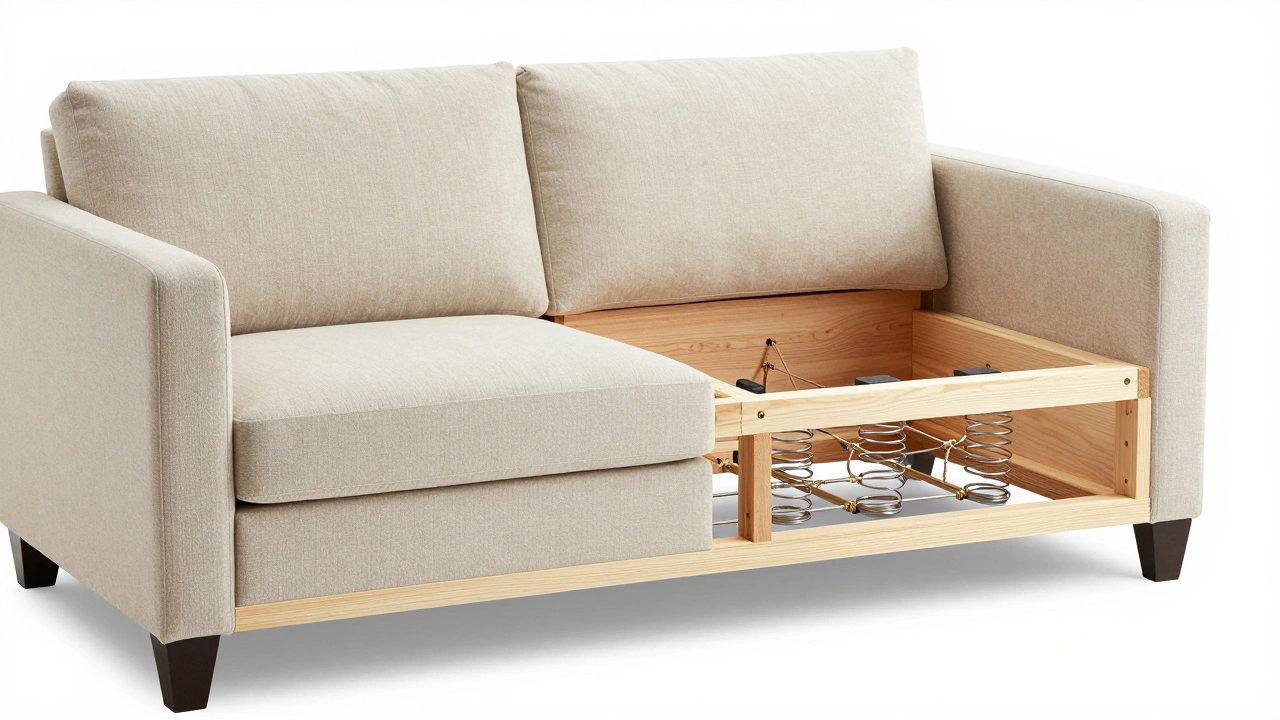
Ever sit on a sofa and feel like you're sinking into a black hole? That's a failure of the suspension system. The suspension is what supports the cushions and keeps the seat level. The most common (and cheapest) version is Sinuous Springs are S-shaped wires that run from the front of the seat to the back, typically attached to the frame with clips . They're fine for a guest room, but for a main living room, they can stretch out over time.
If you want a "forever sofa," look for Eight-Way Hand-Tied Springs are a system where springs are tied by hand in eight different directions, ensuring the tension is perfectly balanced . This is the gold standard. It means the sofa won't develop that annoying dip in the middle after two years. If you can't find this, a "no-sag" spring system is a decent middle-ground alternative.
Check the bottom of the sofa. If the manufacturer allows it, look for a dust cover that can be peeled back. You should see actual springs, not just wide nylon webbing. Webbing is okay for small accent chairs, but in a full-sized sofa, it lacks the bounce-back needed for long-term use.
Cushions: Foam, Down, and the Middle Ground
The filling determines the "feel" and the maintenance level. Low-quality sofas use basic poly-foam. It's cheap and holds its shape initially, but it bottoms out quickly, leaving you feeling the hard frame beneath you.
High-end options usually involve High-Resiliency Foam is a specialized polyurethane foam with a higher density that bounces back to its original shape more effectively . For the ultimate luxury, go for a down-wrapped core. This is a core of high-density foam wrapped in a layer of goose or duck feathers. You get the support of the foam with the cloud-like softness of the down.
A quick pro tip: push your hand deep into the cushion. If you can feel the spring or the wood frame immediately, the foam is too thin. If the cushion takes a long time to pop back up after you stand, it's likely low-density foam that will flatten within a year. You want a quick, firm snap-back.
Fabric: More Than Just a Color
You might love the look of a cream linen sofa, but if you have a dog or kids, that sofa is a ticking time bomb. When checking quality, don't just look at the color; look at the Martindale Test is a standardized method used to measure the abrasion resistance of fabrics by rubbing a sample until the fabric breaks . This is often referred to as the "rub count."
For a home sofa, you want a rub count of at least 15,000 to 20,000. If it's a high-traffic family room, aim for 30,000+. Performance Fabrics, such as those made from treated polyester or acrylic, are designed to repel liquids and resist staining, making them far superior to basic cotton or linen for longevity .
Run your hand along the seams. Are there loose threads? Is the stitching straight? If you see gaps in the seams or uneven stitching in the showroom, those areas will be the first to rip under the pressure of someone sitting down quickly.

The Final Inspection: Red Flags to Watch For
Before you swipe your card, do a final walk-around. Check the legs. Are they solid wood or cheap plastic painted to look like wood? Solid legs are bolted on; plastic ones are often glued. Bolted legs can be replaced if they break; glued ones usually mean you have to toss the whole sofa.
Check the weight. A surprisingly light sofa is usually a sign of thin materials-cheap frames and low-density foam. A quality sofa has some heft to it because of the hardwood and heavy-duty springs.
Ask about the warranty. A company that offers a 10-year frame warranty is confident in their build. A "limited 1-year warranty" on a 2,000-pound piece of furniture is a sign that they expect it to fail shortly after the guarantee expires.
Is a higher price always a sign of better quality?
Not necessarily. You often pay for the brand name, the designer's signature, or the showroom's expensive rent. A very expensive sofa could still have a plywood frame if it's focused purely on fashion. Always check the internal specs (frame and suspension) rather than the price tag.
What is the best fabric for a high-traffic living room?
Performance fabrics, specifically high-rub count polyesters or treated acrylics, are the best. They resist staining and wear much better than natural fibers like linen or cotton, which tend to pill and stain more easily.
Does "hand-tied" actually matter for the average user?
Yes, if you plan to keep the sofa for more than five years. Hand-tied springs prevent the cushions from shifting and sliding, and they maintain the "crown" of the seat, meaning you won't end up with a permanent dip where you always sit.
Can I fix a sagging sofa?
If the foam has collapsed, you can replace the cushion inserts. However, if the springs have stretched or the frame has cracked, it's a very expensive and difficult repair that often costs more than a new mid-range sofa.
What does "kiln-dried" actually do?
It removes the moisture from the wood in a controlled way. This prevents the wood from warping or shrinking once it's in your home, which in turn prevents the frame from creaking or becoming unstable over time.
Next Steps for Your Search
If you're just starting your search, head to a few different showrooms. Don't just sit-shake, push, and poke. Ask for the "spec sheet" of the sofa; if the salesperson can't tell you what the frame is made of or what the rub count of the fabric is, they're selling you on looks, not quality.
For those on a budget, look for "second-quality" or outlet pieces from high-end brands. You can often find a hardwood frame with a small cosmetic scratch for half the price of a brand-new, low-quality sofa from a big-box store.
Write a comment