
Corner Sofa Suitability Checker
Is a Corner Sofa Right for You?
Answer the following questions to see how a corner sofa might impact your living space.
Verdict:
Low Risk- Moving them is a nightmare due to their sheer bulk.
- They often create "dead zones" in the corner that are hard to clean.
- Changing your room layout is nearly impossible once they're placed.
- The corner seat is often the least comfortable spot for adults.
- They can make a small room feel claustrophobic if not sized correctly.
The Space Trap: Why Big Isn't Always Better
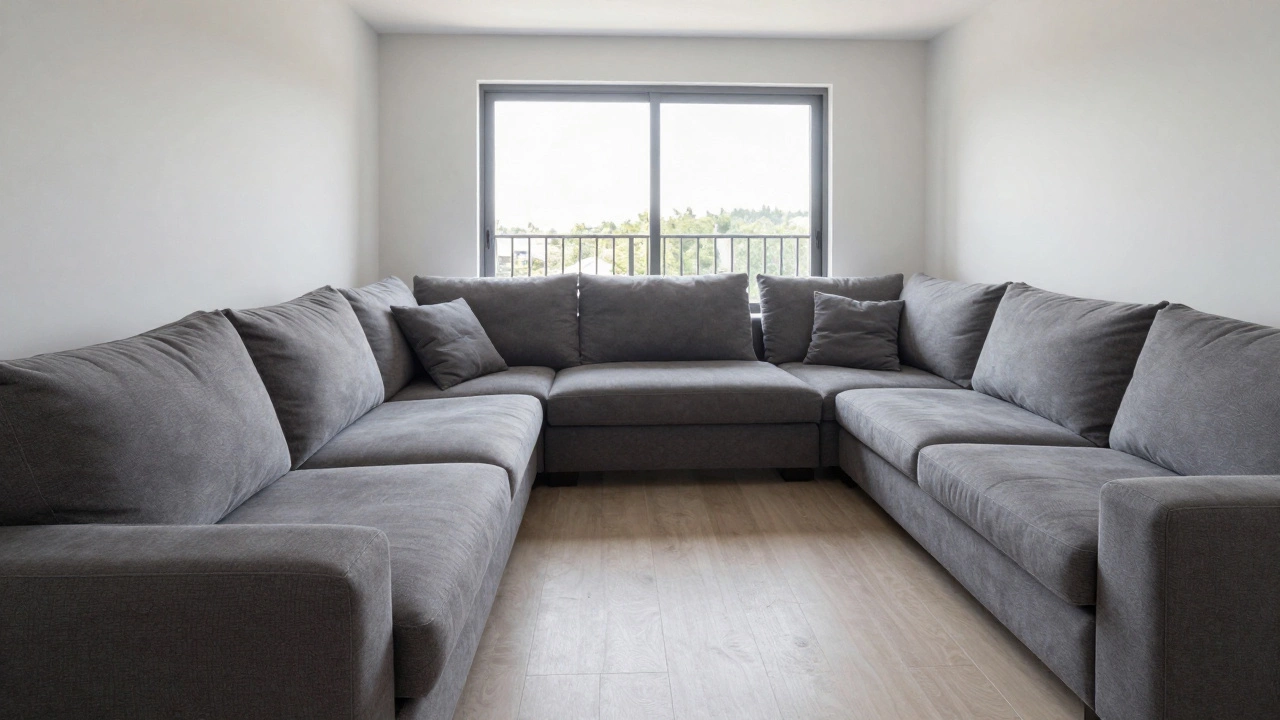
The biggest shock for most people is how a Corner Sofa is an L-shaped seating arrangement designed to fit into a corner or divide a room actually affects the flow of a house. When you're browsing in a showroom, the sofa looks manageable because the room is a giant, empty warehouse. At home, it's different. An L-shaped design naturally blocks off a section of the room. If you place it incorrectly, you might find yourself walking a long, awkward detour just to get to the kitchen or the balcony.
Think about your "traffic lanes." In a standard room, people move in straight lines. A sectional cuts those lines in half. If the sofa is too deep, it doesn't just take up space-it kills the visual openness of the room. You end up with a living area that feels more like a padded cell than a cozy lounge. If you have a narrow room, a corner sofa can act like a wall, effectively splitting your space into two smaller, less useful zones.
The Logistics Nightmare: Delivery and Moving
Let's talk about the part no one mentions in the brochure: the physical act of getting the thing into your house. A standard three-seater is a chunky rectangle. A Sectional Sofa is a multi-piece sofa that can be configured in various shapes, typically consisting of several modules a complex geometric puzzle. Because they are so large, they often require multiple modules to be transported separately. If you live in a flat with a narrow hallway or a house with a tight spiral staircase, you might find that the sofa simply cannot fit through the door.
Even after the initial delivery, the long-term logistics are a headache. If you decide to move house, a corner sofa is the most stressful piece of furniture you'll own. You can't just slide it onto a dolly; you have to disassemble it, move several heavy blocks, and then hope they still fit together perfectly in the new place. Many people find that the sofa they bought for their current home is completely incompatible with their next one, forcing them to sell it at a loss because it's too big for most buyers.
The "Dead Corner" and Comfort Gaps
There is a specific phenomenon known as the "corner sink." In a Right-Hand Facing or Left-Hand Facing sofa, the very corner where the two sections meet is often a dead zone. For a child, it's a cozy nook. For an adult, it's a place where you can't properly stretch out your legs or lean back comfortably. You end up wedged in a 90-degree angle, which isn't great for your lower back during a long film.
Furthermore, the corner is a magnet for crumbs, coins, and remote controls. Because the cushions meet at an angle, there's often a gap or a deep crease that acts like a vacuum for everything in your house. Cleaning under a corner sofa is also significantly harder. Unlike a sofa with legs that you can easily vacuum under, many modern corner designs sit flush against the floor, meaning dust bunnies build up in the corner of the room where you can't reach without moving a 200kg piece of furniture.
| Feature | Corner Sofa | Standard 3-Seater |
|---|---|---|
| Seating Capacity | High (5-8 people) | Medium (3 people) |
| Room Flexibility | Low (Fixed Position) | High (Easy to move) |
| Cleaning Effort | High (Corner gaps) | Low (Easier access) |
| Delivery Difficulty | High (Multi-part) | Medium (Single unit) |
| Comfort Distribution | Uneven (Corner dip) | Consistent |
The Layout Lock-In: No More Rearranging
One of the biggest downsides is the loss of versatility. If you have a pair of matching sofas or a sofa and two armchairs, you can change the vibe of your room every few months. You can move the chairs to face the window or pivot the sofa toward the fireplace. A corner sofa locks you into a specific floor plan. Once it's in, it's practically part of the architecture.
If you realize three months later that the light hits the room differently in winter and you'd prefer the sofa to face the other way, you're out of luck. Unless you have a modular system with a reversible chaise, you are stuck. This "layout lock-in" can make a room feel stale over time. You can't just "shift things around" to refresh the space; you'd have to move the entire heavy base, which is often a two-person job and a recipe for scratching your hardwood floors.
The Price of Excess Fabric
Let's talk money. More surface area means more material. Because corner sofas use significantly more fabric, leather, or velvet than a standard sofa, the price jumps quickly. You aren't just paying for more seating; you're paying for the extra structural framing and the massive amount of foam and filling required to keep the L-shape stable.
Then there's the maintenance. With a larger surface area, there's more space for stains to happen. If you have kids or pets, a corner sofa is a giant target. Replacing a cover for a massive sectional is far more expensive than replacing a throw pillow or a single cushion cover for a smaller sofa. If the fabric on one section wears out faster than the other-which often happens because people tend to sit in the "main" part more than the "extension"-you end up with a mismatched piece of furniture that looks patchy.
The Social Dynamic: Proximity vs. Privacy
While they are marketed as "social" furniture, corner sofas can actually create awkward social dynamics. In a standard seating arrangement, people sit opposite each other, which is the natural position for conversation. On a corner sofa, most people are sitting at a 90-degree angle to one another. This means you're often talking to the side of someone's head rather than looking them in the eye.
Moreover, the person in the corner is often "trapped." If someone needs to get up from the middle of the L-shape, the person in the corner has to shift or move to let them out. It lacks the individual autonomy of having separate chairs. If you're hosting a formal gathering, a corner sofa can feel too casual, almost like everyone is huddling in a pile rather than engaging in a structured conversation.
Will a corner sofa make my small room look smaller?
Yes, it usually does. Because they take up two walls and block a large portion of the floor, they reduce the visible "floor area." To avoid this, choose a model with raised legs rather than a blocky base, and stick to light colors to keep the room feeling airy.
Are modular corner sofas better than fixed ones?
Absolutely. Modular sofas allow you to move the individual sections around, meaning you can change the orientation from left-facing to right-facing or even break them apart into smaller sofas and chairs. This solves the "layout lock-in" problem and makes delivery much easier.
How do I prevent the "dead corner" from being useless?
The best way is to use the corner for a specific purpose, like a place for a large side table or a dedicated "snuggle zone" with extra throw pillows. If you're buying new, look for designs with a slightly recessed corner or a curved edge to make the transition between sections more natural.
Do corner sofas wear out faster?
Not necessarily, but they wear out unevenly. The part of the sofa closest to the TV or the door tends to get used 80% of the time, while the far end of the L-shape remains pristine. This can lead to visible sagging in one area and firm cushions in another.
Is it hard to find a coffee table that fits a corner sofa?
It can be. Rectangular tables often leave too much empty space on one side and not enough on the other. Round or oval coffee tables are usually the best bet as they soften the harsh angles of the sofa and allow for easier movement around the room.
Final Advice for the Undecided
If you're still on the fence, do a "tape test." Take some masking tape and mark out the exact dimensions of the sofa on your living room floor. Leave it there for a full weekend. Walk around it. See how it affects your path to the door. If you find yourself stepping over the tape or feeling squeezed, a corner sofa isn't for you. You'd be much better off with a standard sofa and a couple of high-quality armchairs, which give you the same amount of seating but infinitely more freedom.
Write a comment